LCD Modules for UPS and Battery Systems
UPS equipment, battery management systems, industrial energy storage cabinets, and power backup terminals need displays that communicate critical information quickly. Operators may need to check battery percentage, load level, input and output status, alarms, fault codes, runtime, temperature, and service menus. In these systems, the LCD module is part of the reliability story, not just a decorative user interface.
Sunshine Display supplies LCD display modules for industrial and OEM applications, including small, medium-size, and larger color TFT LCD modules up to 32 inches. These modules are suitable for UPS front panels, BMS terminals, energy storage cabinets, power distribution equipment, charger systems, and industrial power control devices. This is different from consumer phone or TV displays, where appearance and refresh-driven media use are usually the main priorities.
UPS and battery system LCD modules need clear power status, alarm visibility, thermal reliability, and long supply planning.
Power Status Must Be Readable at a Glance
Power backup equipment is often checked during maintenance, commissioning, alarms, or abnormal operation. The display should make key status information obvious: normal mode, battery mode, bypass, fault, load percentage, remaining runtime, and battery health.
Large values and clear icons are useful because operators may not have time to study a complex screen. The LCD resolution should match the user interface density. If the display needs to show trend data, menu trees, and detailed diagnostic codes, a higher resolution or larger module may improve usability.
For panels viewed from the side or from different operator positions, IPS TFT LCD modules can help maintain contrast and color stability. For controlled indoor cabinet interfaces, standard TFT LCD modules may be suitable when cost, size, and supply stability are the main priorities.
Alarm Visibility Is a Safety and Service Issue
UPS and battery systems may use alarm colors, warning icons, audible indicators, and fault codes. The LCD module should support enough contrast and brightness for these warnings to remain visible after final assembly.
Engineers should test real alarm screens, not only normal operation screens. Red, yellow, green, gray, and white states should remain distinct behind the cover lens or front panel. If the device is installed in a dim electrical room, the display should also avoid excessive glare while staying readable.
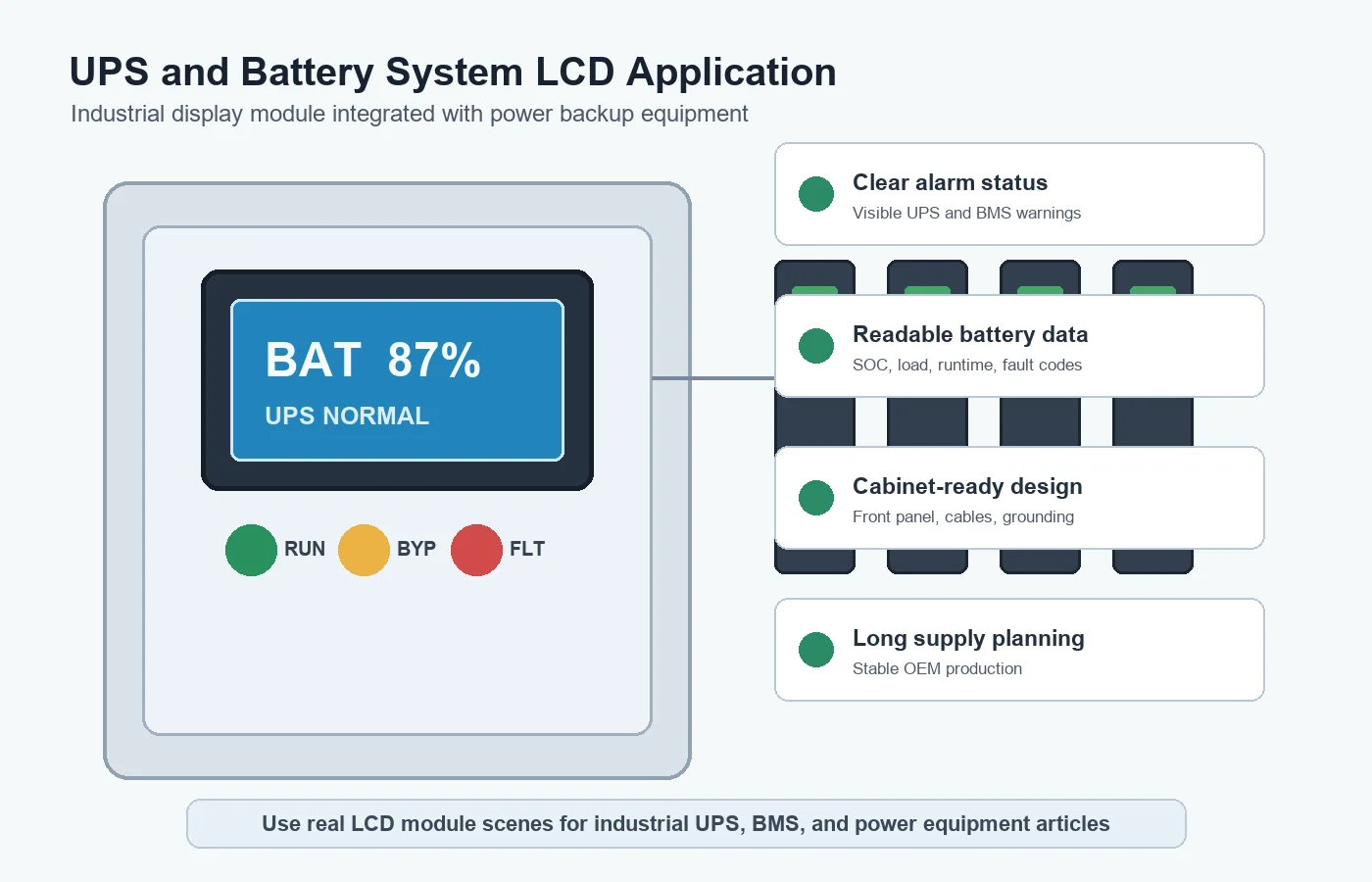 Power backup display selection should consider alarm clarity, battery data, input workflow, heat, electrical noise, and lifecycle.
Touch or Keypad Depends on the Product
Some power systems use membrane keys or physical buttons because they are simple, familiar, and easy to operate during service. Others use capacitive touch for a sealed and modern front panel. The best input method depends on the enclosure, gloves, cleaning conditions, safety requirements, and menu complexity.
Projected capacitive touch can work well when the product needs a flat front surface. However, final touch behavior depends on cover glass thickness, grounding, touch controller tuning, front gasket design, and electrical noise. Sunshine Display's capacitive touch TFT LCD modules are relevant when OEM teams need an integrated display and touch solution for industrial power systems.
Heat and Electrical Noise Need Early Review
UPS cabinets, battery systems, and power conversion equipment can generate heat and electrical noise. The LCD module may be close to power supplies, fans, relays, switching devices, long cables, or metal enclosures. These conditions can affect backlight lifetime, display communication, touch stability, and system reset behavior.
Engineers should review power ripple, grounding, shielding, cable routing, ESD protection, and connector position. The LCD should be tested inside the actual cabinet or terminal, because a bench setup will not show all thermal and electrical risks.
If the application may face cold rooms, outdoor shelters, or hot electrical cabinets, review wide temperature TFT LCD modules early. Product-level validation should still include enclosure heat, backlight setting, and long operating hours.
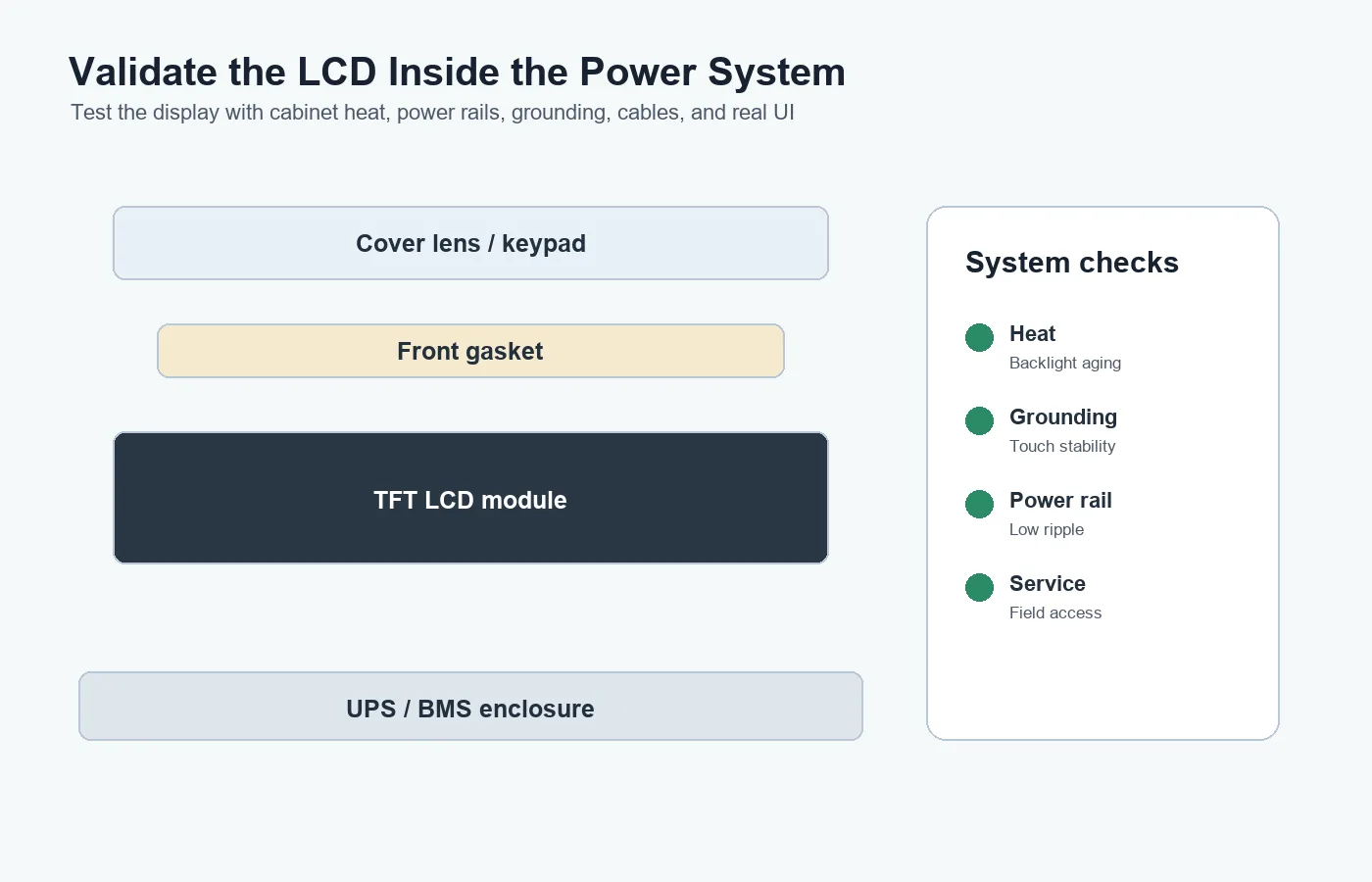 Validate the LCD module with enclosure heat, grounding, power rails, service access, and real status screens.
Mechanical Design Affects Serviceability
UPS and battery equipment often require field service. The LCD module should be mounted in a way that protects the display, supports the cover lens or keypad, and allows reasonable replacement if needed. A difficult-to-service front panel can increase maintenance time and cost.
Before tooling, compare the LCD drawing with the enclosure opening, active area, viewing area, FPC exit, connector position, gasket compression, PCB location, and cable route. Poor mechanical fit can create pressure marks, cable damage, bezel shadows, or inconsistent assembly.
Lifecycle Planning Is Critical for Power Equipment
Industrial power products may stay in production for many years and remain in service even longer. A display change can affect firmware, front-panel tooling, cable design, labels, inspection procedures, and service manuals. Buyers should confirm lifecycle expectations, approved drawings, change notification, alternative options, packaging, and forecast planning.
When reviewing Sunshine Display's LCD display module product range, OEM teams should evaluate size, brightness, interface, touch structure, temperature range, and supply stability together.
Buying Advice for OEM Teams
Before selecting an LCD module for UPS or battery equipment, define the product type, screen size, UI density, alarm requirements, input method, brightness target, operating temperature, electrical noise risk, enclosure structure, service strategy, and expected production life.
Sunshine Display supports industrial LCD display modules for OEM applications up to 32 inches. If your project involves UPS panels, BMS terminals, energy storage systems, charger cabinets, or power control equipment, contact Sunshine Display to review display size, touch or keypad structure, mechanical drawings, and validation requirements.
FAQ
What LCD module is suitable for UPS equipment?
The right module depends on screen size, status information, brightness, viewing angle, input method, enclosure design, operating temperature, electrical noise, and lifecycle.
Should UPS panels use capacitive touch?
Capacitive touch is useful for sealed front panels and menu-driven interfaces, but physical keys may be better for some service workflows. The input method should match the real use case.
Why does heat matter for an LCD module?
Heat can affect backlight lifetime, optical performance, adhesive behavior, touch stability, and long-term reliability. Cabinet-level testing is important.
Can electrical noise affect touch LCD modules?
Yes. Noise from power conversion, relays, cables, and grounding issues can cause false touch, drift, communication errors, or reset behavior.
How can buyers reduce long-term display risk?
Confirm lifecycle, approved drawings, change notification, alternative modules, packaging, inspection criteria, and forecast planning before volume production.