LCD Modules for Weighing and Metering Terminals
Industrial weighing and metering terminals need displays that operators can read quickly and trust every day. These products may show weight values, flow data, process totals, alarms, tare status, unit changes, calibration prompts, and communication states. The LCD module is not only a visual part; it directly affects operating speed, accuracy perception, service work, and user confidence.
Sunshine Display supplies LCD display modules for industrial and OEM applications, including small, medium-size, and larger color TFT LCD modules up to 32 inches. These modules are suitable for weighing controllers, metering terminals, industrial scales, batching equipment, data collection devices, and field measurement systems. This is different from consumer phone or TV displays, where the design priorities and supply models are not the same.
Weighing and metering terminals need readable values, stable operation, suitable touch or keypad input, and long supply planning.
Large Values Must Be Easy to Read
A weighing or metering terminal usually needs large numeric values. Operators may read the screen while standing, from an angle, or while handling materials. If digits are too small, too thin, or low contrast, the device becomes harder to use even if the electronics are accurate.
Resolution should match the information layout. A basic terminal may only need large values and status icons, while a more advanced controller may need trend data, menu pages, recipes, or alarm lists. The LCD module should be evaluated with the real user interface, not only a demo image.
For applications where operators view the screen from different positions, IPS TFT LCD modules can help maintain readability and color stability. For controlled indoor equipment with a fixed viewing position, standard TFT LCD modules may be a practical and cost-effective choice.
Status Indicators Need Clear Visual Priority
In industrial terminals, the numeric value is only part of the screen. Users also need to see status indicators such as zero, stable, net, gross, tare, overload, communication, battery, alarm, and unit selection. These indicators should be visible without distracting from the main value.
The LCD module should support sufficient contrast for both large digits and smaller labels. If the product uses color status icons, the color should remain distinguishable after the display is mounted behind a cover lens or front panel.
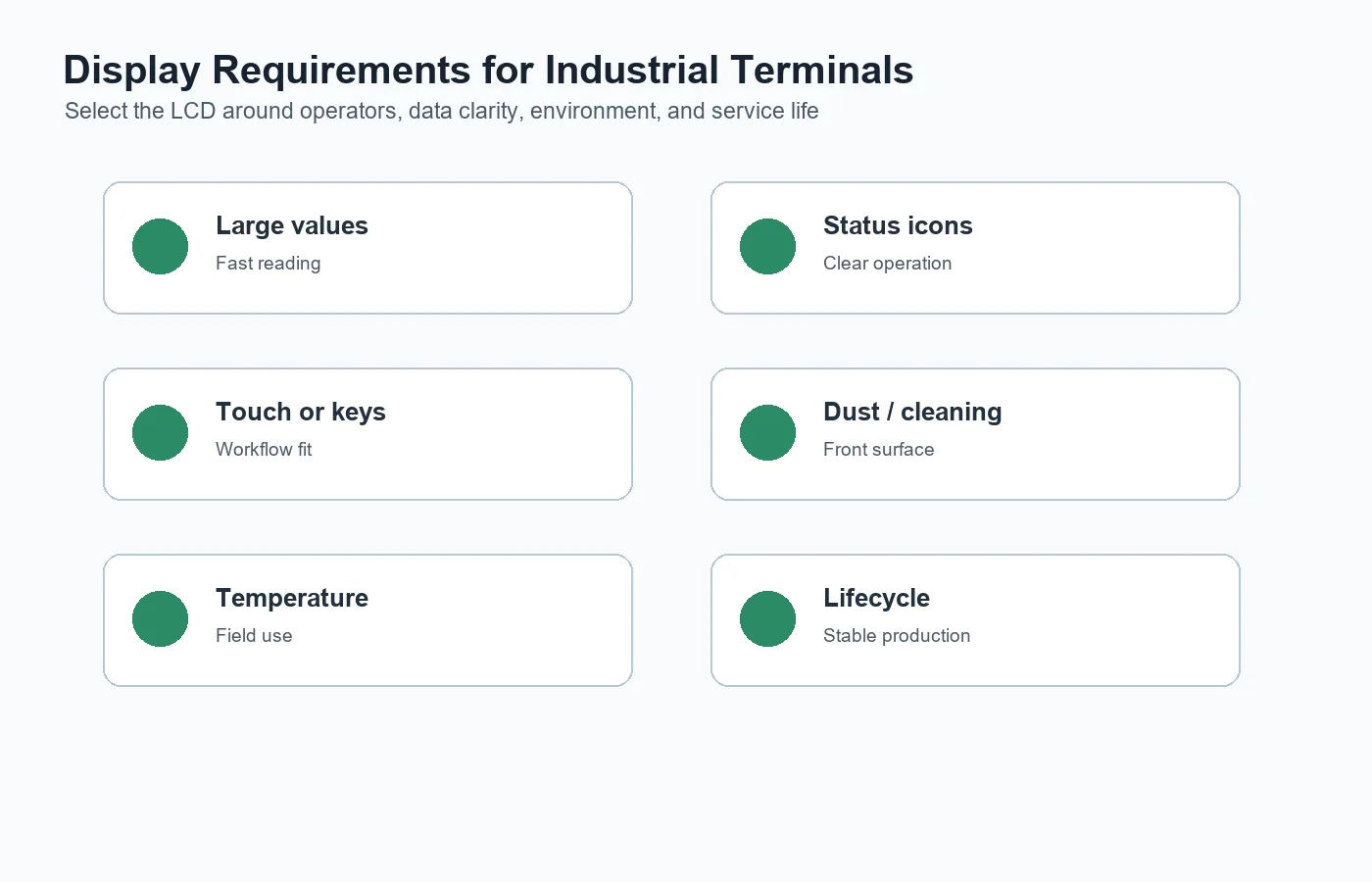 Industrial terminal display selection should consider value readability, status icons, input workflow, front surface, temperature, and lifecycle.
Touch or Keypad Depends on the Workflow
Some terminals use a membrane keypad, while others use touch operation. The right choice depends on gloves, cleaning conditions, operating speed, safety requirements, and whether the device needs a sealed front surface.
Projected capacitive touch can work well for modern terminals with a flat front panel, but the final result depends on cover glass thickness, grounding, controller tuning, and enclosure design. Sunshine Display's capacitive touch TFT LCD modules are relevant when OEM teams need an integrated display and touch solution. If physical keys are required, the LCD should still be reviewed with the keypad, cover lens, and front gasket together.
Environment and Cleaning Should Be Included Early
Weighing and metering terminals may be used in factories, warehouses, process equipment, cold rooms, outdoor shelters, or vehicle-mounted systems. Dust, vibration, cleaning chemicals, humidity, and temperature variation can all affect the display system.
If the terminal may face cold or heat, review wide temperature TFT LCD modules early. The complete product should also be tested for cover lens reflection, gasket aging, enclosure heat, and backlight performance after long operating hours.
Mechanical Fit Affects Field Reliability
The LCD module drawing should be checked against the terminal enclosure before tooling. Important dimensions include outline size, active area, viewing area, total thickness, FPC exit direction, connector position, cover lens overlap, and mounting structure.
Poor mechanical fit can create pressure marks, cable damage, display misalignment, dust gaps, or service difficulty. A loose LCD sample on a desk does not reveal these risks. The display should be tested inside the real housing with the actual keypad, front lens, PCB, power cable, and mounting method.
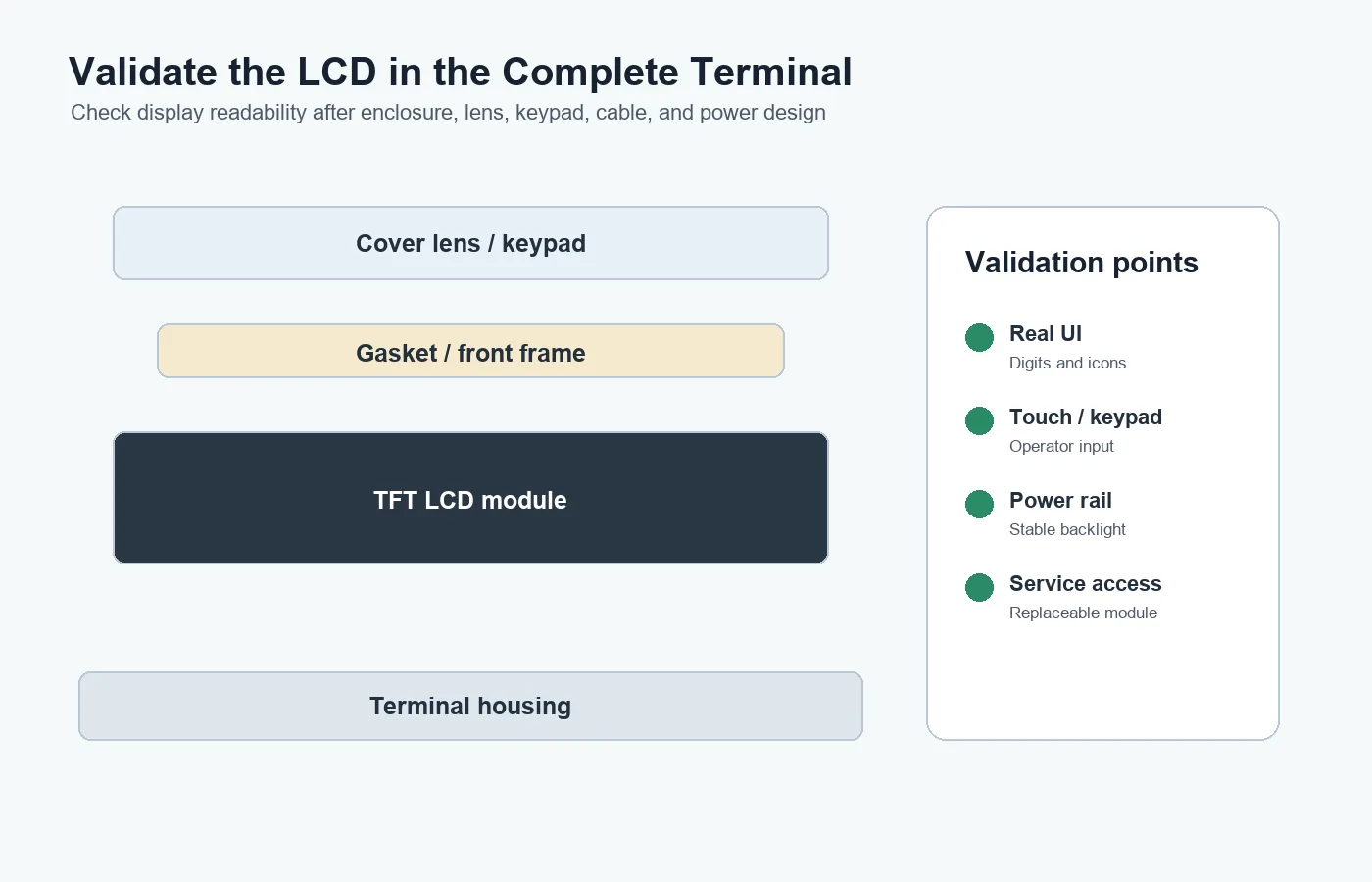 Validate the LCD module with cover lens, keypad, gasket, housing, power rail, and real user interface.
Electrical Stability Matters for Measurement Products
Weighing and metering equipment may include load cells, analog front ends, power supplies, communication modules, relays, and long cables. Electrical noise can affect display communication, touch behavior, backlight stability, or system reset behavior.
Engineers should review grounding, shielding, signal routing, ESD protection, power ripple, and connector position. If the LCD module uses an interface cable, cable length and routing should be validated in the final terminal, not only on a development board.
Lifecycle Planning Protects Production
Industrial terminals often stay in production for many years. A display change can affect the housing, cover lens, UI layout, cable, firmware, keypad structure, inspection process, and service documents. Buyers should confirm lifecycle expectations, change notification process, approved drawings, alternative options, packaging, and forecast planning.
When reviewing Sunshine Display's LCD display module product range, OEM teams should consider not only current price and sample availability, but also long-term integration stability.
Buying Advice for OEM Teams
Before selecting an LCD module for a weighing or metering terminal, define the product type, screen size, viewing distance, UI density, input method, brightness target, cover lens design, cleaning conditions, operating temperature, electrical noise risk, enclosure structure, and expected production life.
Sunshine Display supports industrial LCD display modules for OEM applications up to 32 inches. If your project involves weighing controllers, metering terminals, industrial scales, batching equipment, or field measurement devices, contact Sunshine Display to review display size, touch or keypad structure, mechanical drawings, and validation requirements.
FAQ
What LCD module is suitable for weighing terminals?
The right module depends on display size, digit readability, viewing distance, brightness, input method, enclosure design, operating temperature, electrical noise, and lifecycle.
Should weighing equipment use a touch LCD module?
Touch can be useful for menu-driven products, but membrane keys may still be better for fast operation, gloves, or harsh cleaning. The input method should match the real workflow.
Why are large digits important on metering displays?
Operators often read values quickly while working. Large, high-contrast digits reduce mistakes and improve confidence in the terminal.
Does cover lens design affect LCD readability?
Yes. Cover lens reflection, printing mask, thickness, bonding, and gasket design can change readability and touch performance.
How can buyers reduce long-term display risk?
Confirm lifecycle, approved drawings, change notification, alternative modules, packaging, inspection criteria, and forecast planning before volume production.