Different industrial applications require different display technologies, operating characteristics, and integration strategies.
Industrial OEM teams can choose from several screen technologies, but no single display is best for every application. TFT LCD, OLED, and e-paper each offer different advantages in brightness, contrast, power consumption, refresh behavior, environmental performance, and cost.
The right decision depends on what users need to see, how often the information changes, where the equipment operates, and how long the product must remain in production. Sunshine Display supports industrial display modules, including TFT LCD modules up to 32 inches, e-paper display modules, and customized display assemblies for OEM equipment.
TFT LCD: The Practical Choice for Industrial HMIs
TFT LCD remains one of the most versatile technologies for industrial control panels, automation equipment, medical devices, test instruments, energy systems, and machine HMIs.
A TFT LCD uses a backlight to illuminate the image. This allows it to display full-color graphics, live measurements, alarms, menus, process diagrams, and animated interface elements. It can support continuous updates and responsive interaction, making it suitable for equipment that operators actively monitor or control.
Industrial buyers can choose from many sizes, resolutions, interfaces, brightness levels, and touch options. Standard TFT LCD modules provide a practical starting point for most OEM projects.
IPS TFT technology is often selected when the display must remain readable from standing, seated, or side positions. Compared with narrow-viewing-angle alternatives, an IPS TFT LCD module generally provides more stable contrast and color across wider viewing directions.
The main trade-offs are continuous backlight power, heat generation, and backlight aging. Engineers should confirm brightness requirements, expected backlight lifetime, thermal conditions, and whether the backlight can be dimmed when the equipment is idle.
OLED: Strong Contrast for Compact Interfaces
OLED displays generate light at the pixel level and do not require a separate backlight. This enables deep black levels, strong contrast, fast response, and thin module construction.
These characteristics can be useful in compact industrial instruments, handheld diagnostic equipment, laboratory devices, and control units with limited installation depth. OLED is particularly effective when an interface uses dark backgrounds, high-contrast indicators, and frequently changing data.
However, OLED selection requires careful review of operating life and image usage. Static interface elements that remain in the same position for long periods can create uneven pixel aging. High-brightness operation can also influence lifetime.
For industrial products with persistent menus, fixed warning icons, or continuous 24-hour operation, engineers should evaluate the actual UI layout rather than relying only on a general lifetime specification. Screen savers, automatic dimming, and periodic movement of static elements may help, but these strategies must be validated with the intended module.
Availability can also be more limited than TFT LCD in some industrial sizes and resolutions. OEM teams should review supply continuity and compatible alternatives before committing to a long-lifecycle design.
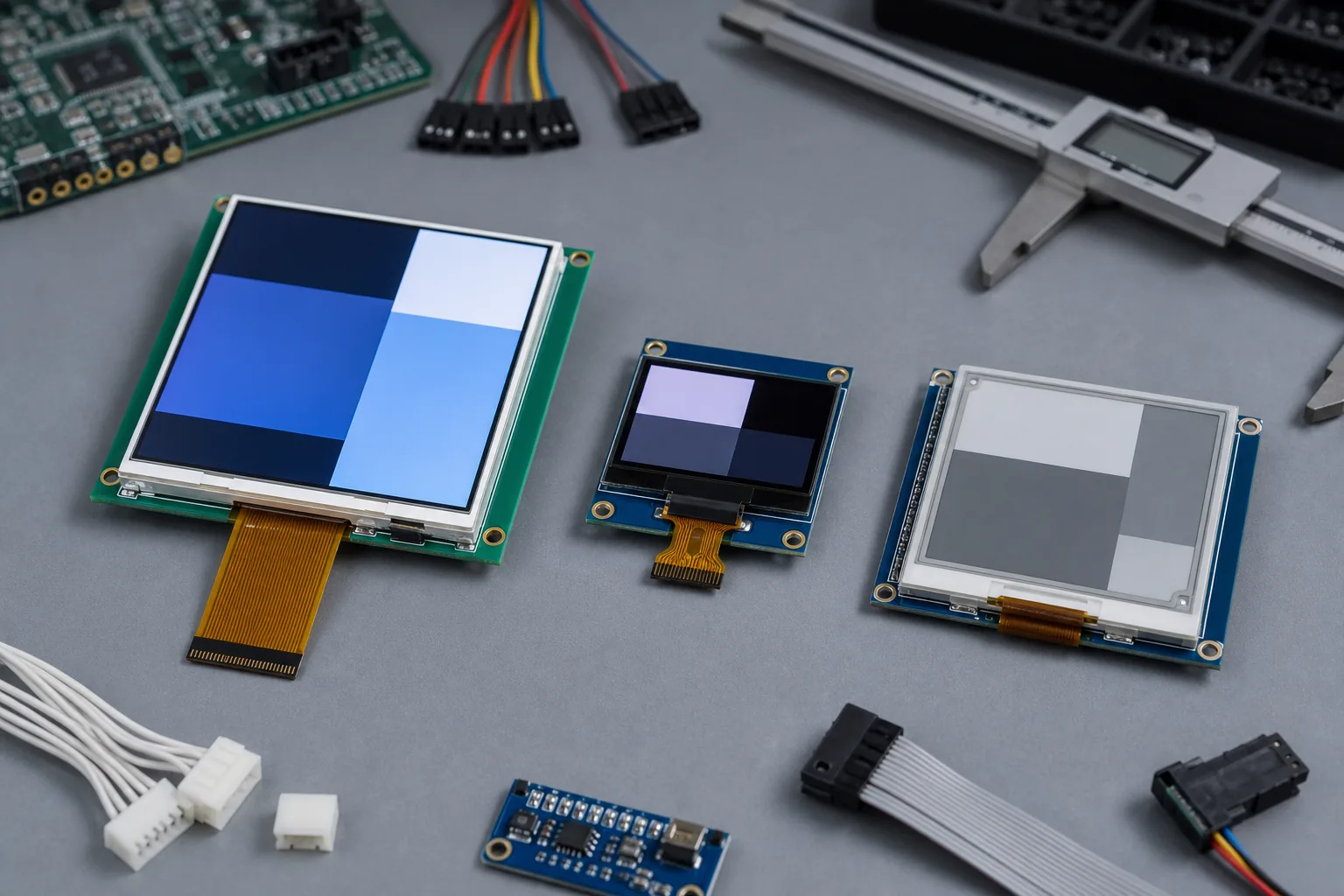 TFT LCD, OLED, and e-paper modules differ in illumination, interface requirements, power behavior, thickness, and refresh performance.
E-Paper: Ideal for Persistent, Low-Power Information
E-paper is a reflective display technology that uses ambient light instead of a conventional backlight. Its bistable behavior allows the image to remain visible without continuous display power.
This makes e-paper suitable for industrial status labels, warehouse identification, maintenance boards, equipment information panels, low-power field instruments, and battery-operated devices. It can remain readable in bright ambient light and offers a paper-like appearance with a wide viewing angle.
E-paper is not normally used for animation or rapidly changing control interfaces. Refreshing takes longer than on TFT LCD or OLED, and some modules use a visible update sequence. Partial refresh may improve speed, but frequent partial updates can influence image quality and should be tested.
Operating temperature is especially important because cold conditions can slow refresh behavior. Engineers should test update speed, ghosting, controller communication, and image quality across the complete temperature range.
For custom products, Sunshine Display can support e-paper module selection as well as OEM development involving controller boards, communication interfaces, enclosures, firmware, batteries, and complete display products.
How to Compare the Three Technologies
The application workflow should guide the selection. Choose TFT LCD when the equipment requires full-color graphics, live process data, responsive touch control, trend charts, alarms, or frequently changing information. It is usually the most flexible choice for factory HMIs and operator panels.
Consider OLED when compact size, deep contrast, fast response, and thin construction are more important than a broad industrial size range. Review static-image behavior and operating life carefully.
Choose e-paper when information changes only occasionally and must remain visible with minimal standby power. It is especially effective for labels, maintenance information, equipment identification, and battery-powered industrial devices.
In some systems, two technologies can work together. A color TFT LCD can provide the main interactive HMI, while an e-paper panel keeps equipment identity or maintenance status visible when the primary controller is sleeping or powered down.
Environmental and Mechanical Requirements
Display technology alone does not determine field performance. Engineers must also consider temperature, vibration, sunlight, dust, moisture, cleaning chemicals, electrical noise, and mechanical stress.
For hot or cold installations, wide-temperature TFT LCD modules may provide a more suitable operating range. Outdoor readability also depends on brightness, contrast, anti-glare treatment, cover-glass reflection, and enclosure shading.
Touch operation should be tested with the intended gloves, front glass, grounding method, and environmental contamination. Capacitive touch TFT LCD modules can support sophisticated industrial interfaces, but the complete mechanical and electrical stack must be validated.
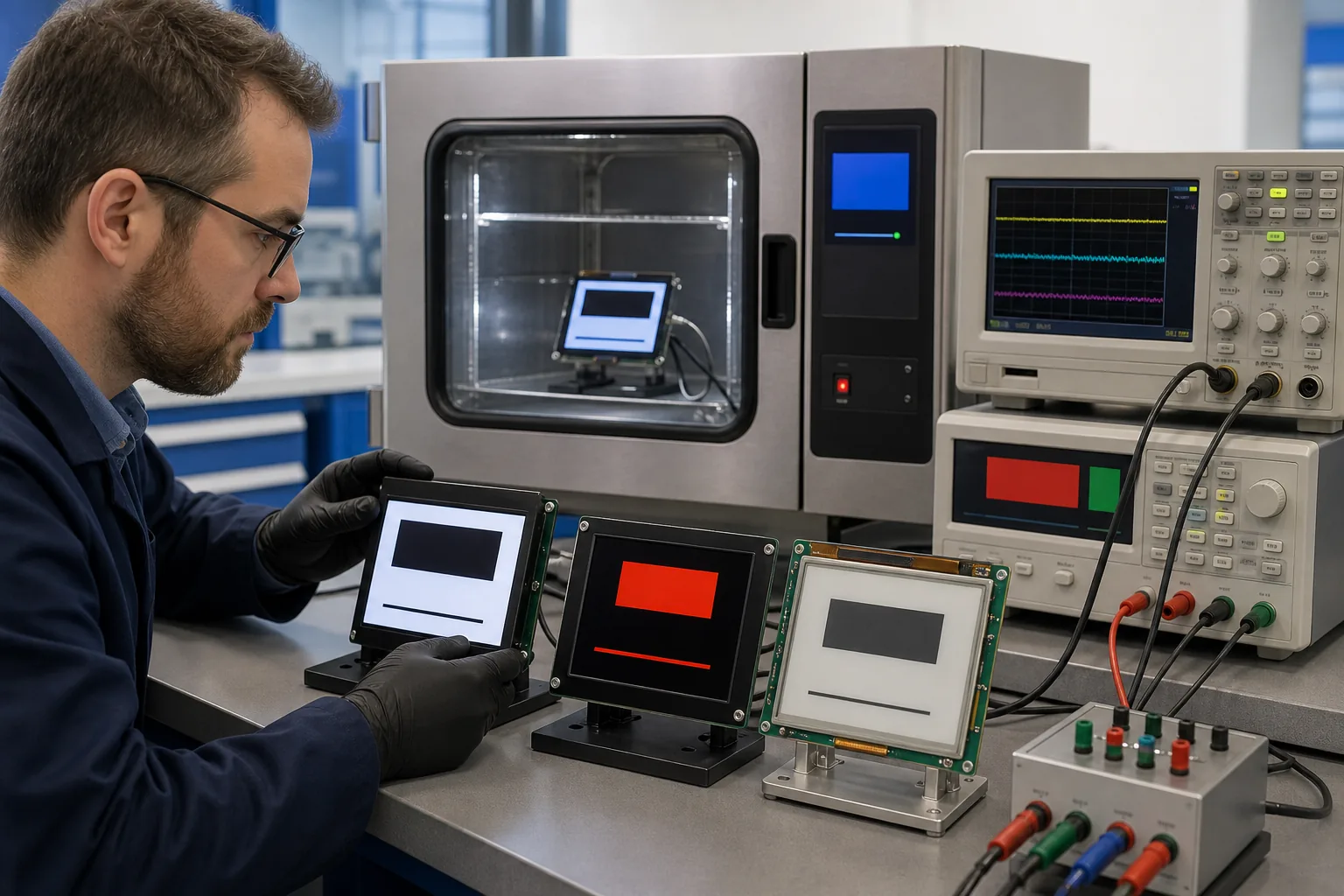 Environmental and system-level testing helps confirm that the selected display technology matches the real industrial application.
Practical Advice for OEM Buyers
Before requesting samples, define the screen size, resolution, interface, brightness, viewing distance, update frequency, power source, operating temperature, touch requirement, expected production volume, and product lifecycle.
Test the real UI content on representative samples. Compare readability, startup behavior, power consumption, refresh performance, thermal behavior, and recovery after communication or power interruptions.
Also ask about module availability, change notification, compatible alternatives, customization limits, tooling costs, and firmware responsibility. A technically suitable display can still create production risk if long-term supply has not been considered.
FAQ
Which display technology is best for industrial control panels?
TFT LCD is generally the most practical option for active industrial control panels because it supports full-color graphics, continuous updates, touch control, and a wide range of sizes and interfaces.
Does e-paper consume no power?
E-paper requires power when the image is updated, but the displayed image can remain visible without continuous display power. System power also depends on the controller, wireless connection, sensors, and update frequency.
Can OLED be used in industrial equipment?
Yes. OLED can work well in compact industrial devices requiring strong contrast and fast response. Engineers should evaluate static-image aging, brightness, temperature, lifecycle, and supply continuity.
Can Sunshine Display customize an industrial display solution?
Sunshine Display can support TFT LCD module selection, touch integration, cover glass, FPC and backlight changes, controller-related requirements, e-paper modules, and custom e-paper OEM products. Contact Sunshine Display to discuss the application and project requirements.