A rugged TFT LCD HMI supports setup, live test state, result review, and controlled operator actions on industrial leak testing equipment.
A leak test is a sequence of controlled decisions: identify the part, close the fixture, establish pressure or vacuum, observe stabilization, run the test, review the result, and decide what happens next. The display is where that sequence becomes visible to the operator. A poorly organized HMI can make a stable test station feel uncertain; a well-designed one helps the operator stay within the approved process.
For OEM teams, choosing a TFT display for industrial leak testing equipment is therefore not simply an exercise in fitting a screen into a metal panel. The HMI must present live information clearly, behave predictably around test transitions, survive the local environment, and integrate with the machine's mechanical and electrical design.
Moment One: Before the Fixture Closes
Before a test begins, the screen should allow the trained operator to confirm the intended context: the selected program or product family, machine readiness, and any condition that prevents the next step. The first view should not force users to decode a crowded dashboard. A clear state indicator and an obvious next permitted action are more valuable than displaying every available controller variable.
Industrial TFT LCD modules are well suited to this active role because they can support changing values, menus, service pages, color emphasis, and responsive interaction. The actual content should still be governed by the test process and machine safety concept, rather than a generic consumer-style interface.
Moment Two: During Pressurization and Stabilization
Once the fixture is closed, the screen has a different job. Operators need to recognize whether the cycle is progressing, holding, or waiting for a condition. Movement and status should be clear without relying solely on color. A technician viewing the display from beside a fixture, through protective glasses, or under bright overhead lights should not have to hunt for the active state.
Review viewing direction, cover-lens reflection, brightness, and the installed height of the cabinet. When off-axis visibility is important, IPS TFT LCD modules can support more consistent image quality over a wider viewing angle. The correct choice is confirmed with an assembled HMI in the intended test-station lighting, not by a panel-only specification.
Moment Three: When a Test Result Needs Attention
A pass or fail state may be simple in the controller, but it needs careful HMI treatment. The operator should be able to distinguish a completed cycle, a process interruption, a fixture problem, and a result that requires the defined escalation path. Provide hierarchy: immediate machine state first, supporting information second, and deeper diagnostics only when the user is authorized to access them.
Avoid presenting a vague red-green result without context. In quality equipment, the display should make it easier to follow the approved response, not invite an operator to guess. Text size, grouping, placement, and acknowledgment flow should be tested with the actual production process.
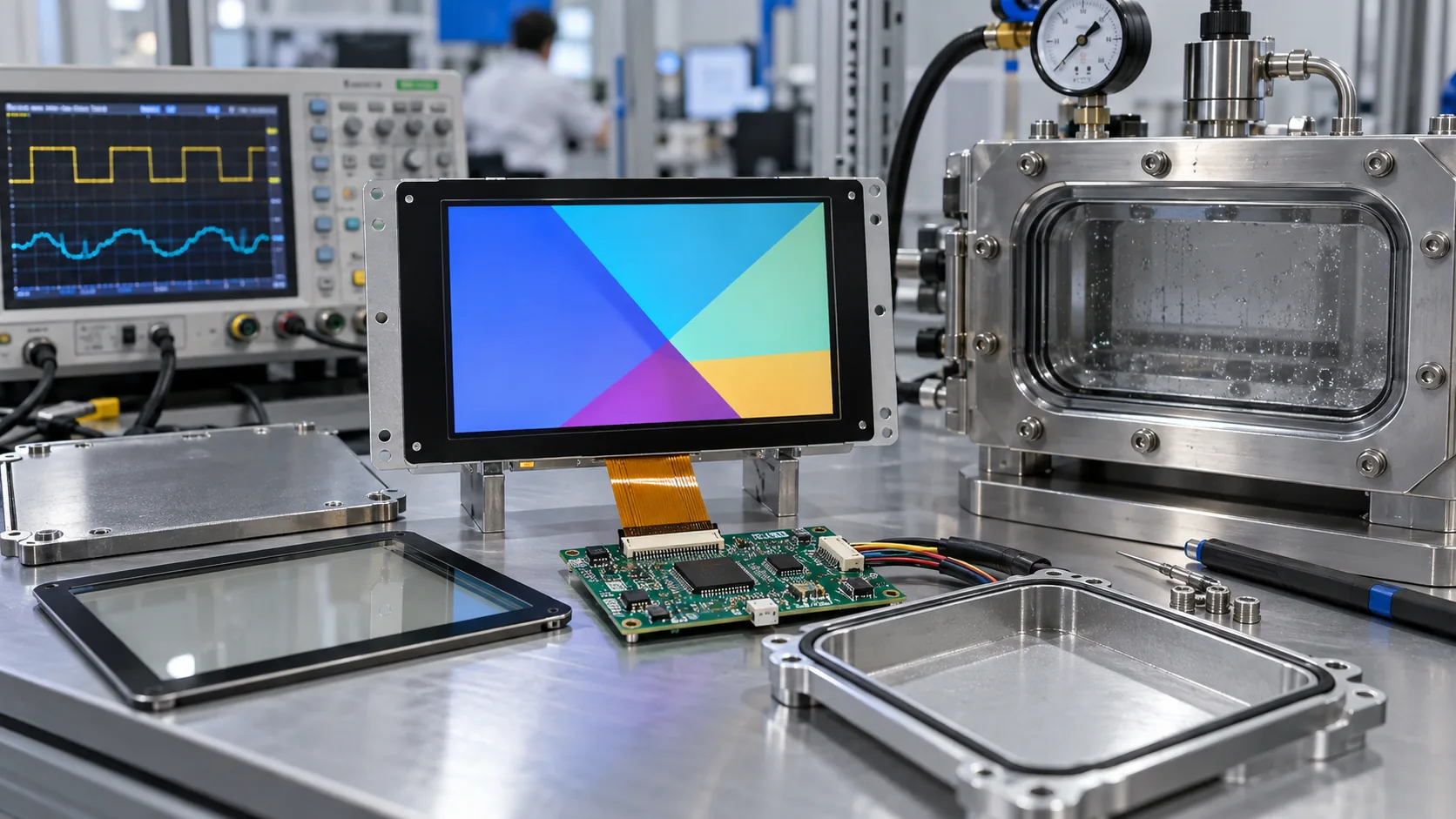 The display, controller, touch lens, enclosure, cable routing, and test-station environment should be evaluated as a complete industrial HMI assembly.
Moment Four: When the Machine Is Serviced
Service is where a bare module choice becomes an industrial HMI design. The TFT, controller board, FPC, front lens, gasket, enclosure, and cable path must fit together with room for assembly and future access. Verify the viewing-area opening, module support, cable bend radius, connector clearance, strain relief, and mounting pressure before the mechanical design is frozen.
If a sealed touch surface is appropriate, capacitive touch TFT LCD modules should be evaluated with the real gloves, cleaning practice, and front-panel stack. Touch is not automatically the right answer; dedicated keys may still serve high-frequency or critical functions better. The strongest design is the one that matches the actual maintenance and operating tasks.
Moment Five: When the Test Station Returns After a Fault
The HMI should also be reviewed through restart, recovery, and communication-loss scenarios. What does the user see after a controller reboot? How is a failed sensor connection presented? Is it clear when data is not current? These questions matter because a display can be technically functional yet still leave an operator uncertain about whether the station is ready for production.
Build a representative prototype with the selected display, controller, lens, enclosure, and application screen. Test normal use, glove interaction, light reflections, power interruption, interface recovery, and the intended diagnostic path. If the installed cabinet faces elevated or low temperature conditions, examine wide-temperature TFT LCD modules against the actual display location, not only the room's general rating.
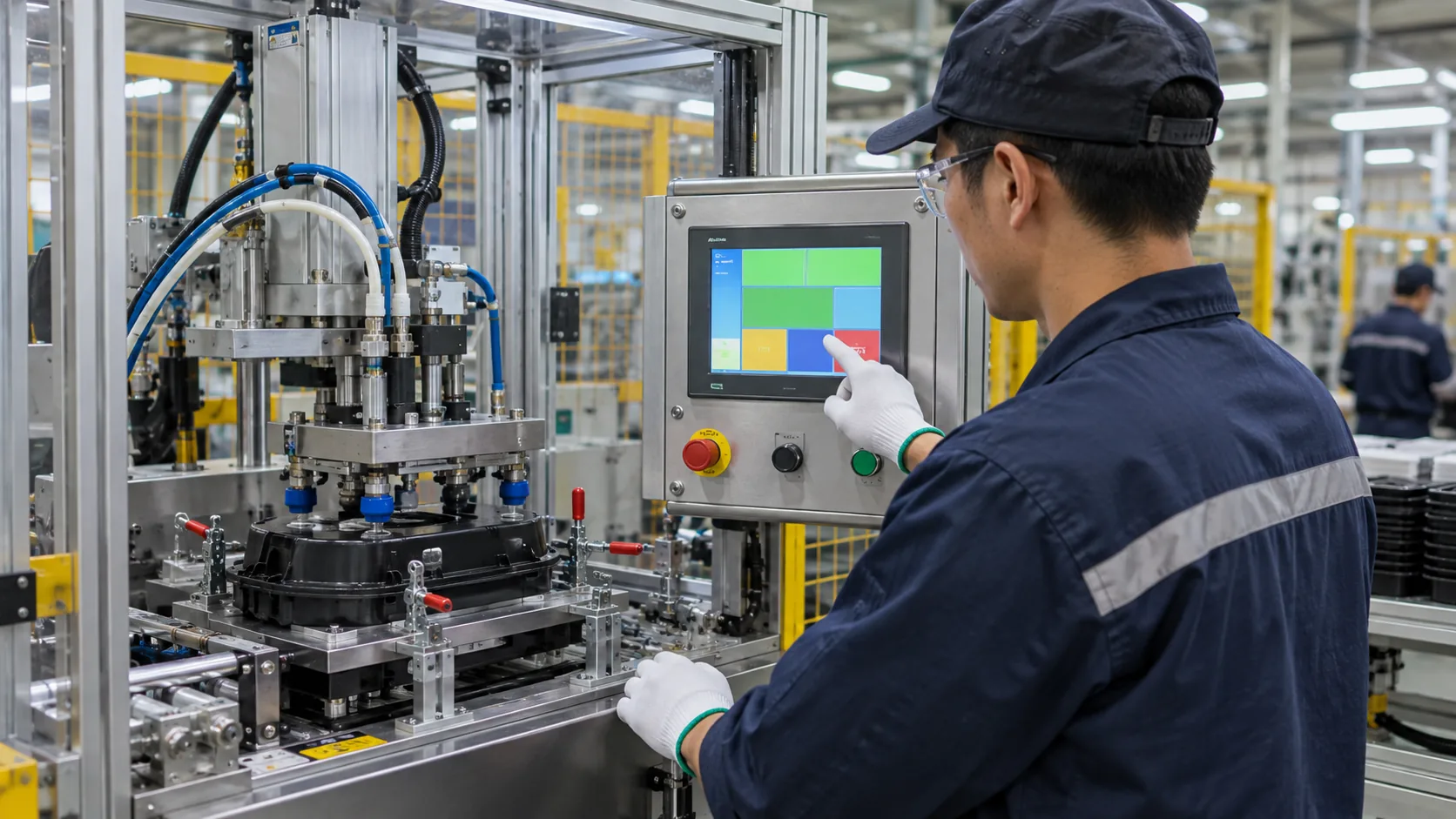 A clear local HMI helps technicians follow approved test steps and identify the next permitted action at a leak-testing station.
Handing the Requirement to a Display Supplier
An effective RFQ starts with the machine task. Describe the leak-test method, operator role, HMI sequence, target display size, active area, resolution, interface, front-panel design, touch or key requirement, operating environment, cleaning exposure, mechanical limits, annual quantity, and lifecycle expectation. Include a simplified screen flow and cabinet drawing when available.
Ask who owns the controller firmware, front-panel assembly, test procedure, supply continuity, and change notification. These are product decisions, not paperwork. Sunshine Display supplies industrial display modules for OEM applications and can help review the display and integration route for industrial test equipment.
The display should support traceability without pretending to be the record system. A station can show a current cycle reference, selected program, result state, or approved service message, while the detailed quality record remains in the designated controller, database, or manufacturing system. Defining that boundary early prevents an HMI from becoming an unreliable substitute for validated production records. It also keeps the operator view focused on the information needed at the station.
Before pilot release, give operators a representative unit during a normal shift. Watch where they pause, which messages they miss, and whether the screen is readable while handling the real part and fixture. Those observations often reveal an optical or workflow issue that cannot be found by checking electrical specifications alone.
The practical measure of a leak-test HMI is simple: can trained users understand the current test state and take the correct next action without delay? Contact Sunshine Display to discuss TFT LCD modules for industrial leak testing, sealing inspection, and test-station equipment.