E-paper display modules can bring persistent, readable information to industrial equipment, storage points and low-power business products.
Businesses exploring low-power e-paper display solutions are usually trying to solve a practical problem: how to keep useful information visible at the point of use without wiring a conventional screen everywhere or replacing paper labels by hand. The strongest projects do not begin with a display technology. They begin with a moment where a person needs to recognize a state, location, instruction, or exception quickly.
E-paper display modules are well suited to information that changes occasionally and must remain visible between updates. They offer paper-like readability, wide viewing angles, thin module options, and bistable image retention. For industrial and OEM products, that can support equipment status surfaces, low-power field devices, warehouse points, service instructions, electronic labels, and custom connected products.
Three Business Signals That E-Paper May Fit
The information is useful even when the product is asleep. A cabinet condition, asset identity, inspection state, replenishment prompt, or scheduled-service message does not need an active backlight to be meaningful. E-paper can retain the most recently approved image while the rest of the system is idle.
The update event is deliberate. E-paper works best when updates correspond to a real event: a work order is issued, stock is moved, an inspection is completed, a schedule changes, or a remote device reports a new state. The refresh is not invisible, so the product should be designed around a realistic update cadence.
The user reads more than they interacts. Many industrial applications need a clearly visible status surface rather than a fast, touch-driven interface. Where users need live trends, rapid menus, or continuous interaction, industrial TFT LCD modules are normally the better active-display choice.
Product Guidance: Start With the Complete Energy Event
Low standby power is only one line in the power budget. A real update can include controller wake-up, sensor activity, wireless communication, data transfer, display refresh, and a return to sleep. Calculate the expected event frequency before selecting a battery or promising a maintenance interval.
Temperature matters as well. E-paper refresh behavior can change in cold conditions, while the enclosure, battery chemistry, and communication hardware have their own limits. Test the actual content, update sequence, and installed environment rather than assuming that a nominal module rating defines the final product.
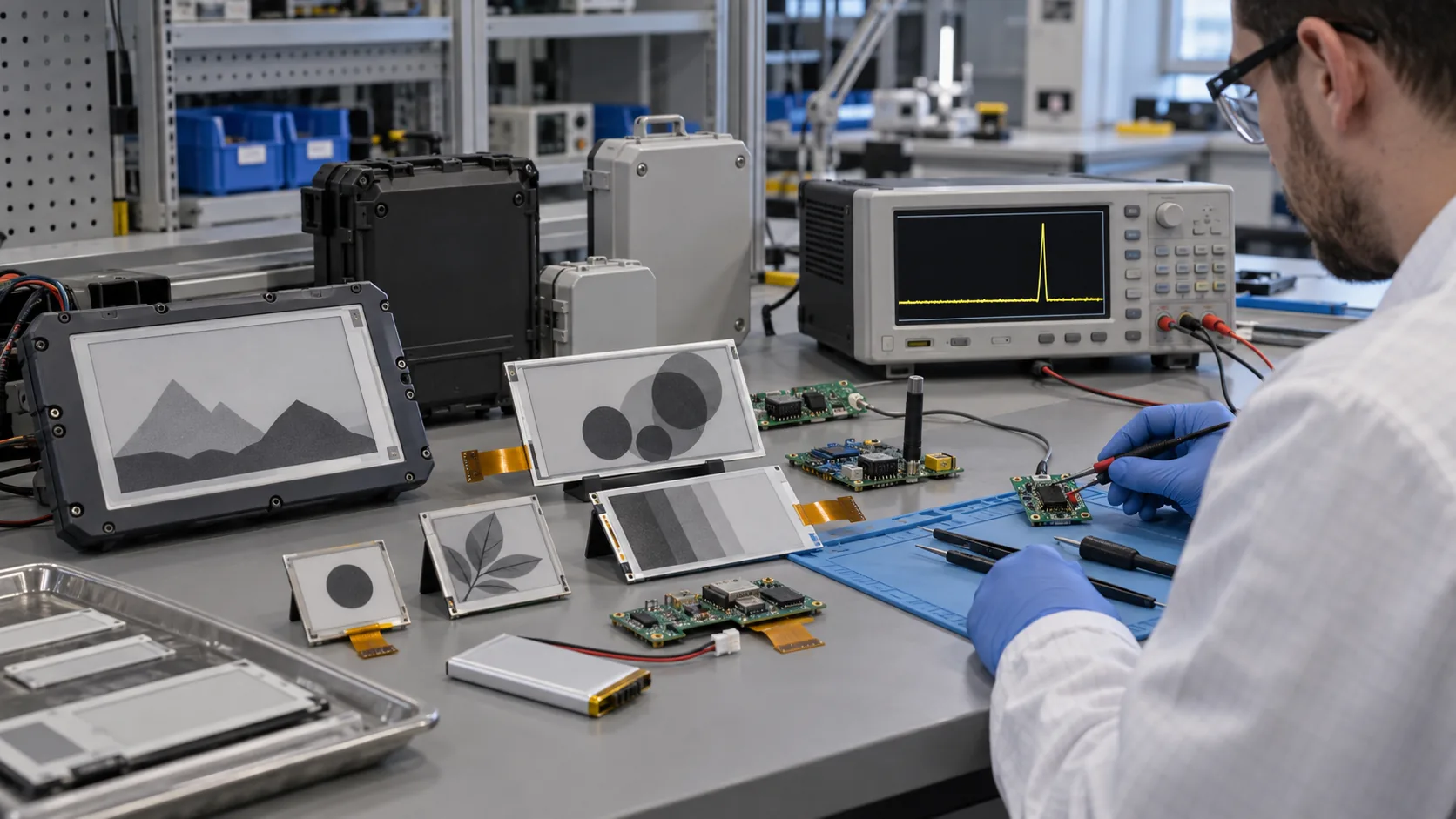 A low-power e-paper solution should be validated across the panel, controller, wireless activity, update cycle, battery system and enclosure.
Practical Application Patterns
Equipment state surfaces. A module on a machine, cabinet, or fixture can retain service state, inspection status, product family, or maintenance ownership. The display should supplement validated safety and control procedures, not replace them.
Warehouse and point-of-use identification. At parts bins, storage cabinets, and kitting areas, e-paper can make selected stock or workflow information easier to see than a paper label. A connected system must still define when a change is confirmed and how stale information is identified.
Low-power industrial field products. Battery-operated instruments, status nodes, and portable equipment can use e-paper for information that must remain readable in ambient light. The product should be designed around refresh timing and task value rather than trying to reproduce a smartphone interface.
Custom OEM products. A complete e-paper product may combine a module, controller, enclosure, front lens, battery or wired power, interface, firmware, mounting strategy, and product-level test plan. Sunshine Display supports industrial display modules and custom e-paper OEM product development around those system requirements.
Know Where the Technology Should Stop
E-paper is not a substitute for every display. It is usually a poor fit for rapidly moving content, video, continuous data visualization, or complex interactive workflows that require immediate feedback. The most successful business designs give e-paper a defined role: persistent information with occasional update events.
Many industrial products use complementary technologies. A TFT HMI handles live operation, while an e-paper panel keeps equipment identity or service status visible between active sessions. For a wider-angle live operator screen, IPS TFT LCD modules can be considered alongside the e-paper product architecture.
Run a Pilot That Produces Decisions
Rather than starting with a large deployment, select one representative site, cabinet type, field product, or workflow. Install the e-paper product in its intended enclosure. Use real status messages, real update triggers, and the people who will use it. Observe whether users can identify the information they need and whether the update behavior fits the operating rhythm.
Test the awkward conditions too: communication loss, a delayed refresh, depleted battery, low temperature, front-window reflection, enclosure opening, and power interruption during an update. A retained image needs a clear freshness strategy, such as a controlled timestamp, synchronization mark, or approved fallback state. Never let an unverified image appear authoritative for a critical decision.
 Persistent e-paper information can help technicians recognize equipment state and follow the appropriate workflow at the point of use.
The RFQ Data Pack That Saves Time
An effective request for quotation describes the job before it lists the display. Provide the intended application, viewing distance, target size, active area, resolution, monochrome or color requirement, interface, controller approach, update frequency, power source, operating temperature, enclosure constraints, communication method, annual volume, and lifecycle expectation. Include mechanical drawings and sample content where possible.
Clarify which party owns the firmware, wireless provisioning, enclosure tooling, production testing, packaging, and field support. For products that also need an active interface, specify the separate HMI role and consider whether capacitive touch TFT LCD modules are needed for the live control surface.
The practical insight is simple: low-power e-paper succeeds when its persistent display behavior matches a real business decision at the point of use. Contact Sunshine Display to discuss e-paper display modules or a custom e-paper OEM product for industrial applications.