Medical Device LCD Display Module Selection Guide
Medical device displays should be selected around readability, reliability, touch design, and long-term supply.
Medical device displays must support clear information, stable operation, and long product lifecycles. A screen may show a beautiful demo image, but the real requirement is whether clinicians, technicians, and patients can read important information quickly and consistently in the final device.
For OEM buyers and engineers, the LCD module should be reviewed as part of the complete medical device system. Size, resolution, brightness, viewing angle, touch panel, cover glass, interface, backlight lifetime, operating temperature, packaging, and supply stability all influence the final product. Sunshine Display supports LCD display modules up to 32 inches for medical, industrial, commercial, and embedded applications.
This guide explains how to select a medical device LCD display module with practical engineering and purchasing considerations.
1. Start With the Medical Use Case
Medical products can have very different display needs. A patient monitor, diagnostic instrument, handheld tester, laboratory analyzer, therapy device, and bedside terminal may all require different screen sizes, UI layouts, and reliability targets.
Before choosing a module, define who will read the screen, how far away they are, what lighting conditions exist, whether gloves are used, whether the device is cleaned frequently, and how long the product is expected to remain in service.
For simple status displays, a compact module may be enough. For waveform review, trend data, imaging, menus, and multi-parameter dashboards, a larger active area and higher resolution may be more appropriate.
2. Choose Size and Resolution Together
Screen size and resolution should match the UI content. Medical interfaces often include numerical values, warning colors, trend charts, icons, waveform graphics, and multi-language text. If the display is too small or the resolution is too low, the UI can become crowded and difficult to read.
If your team is comparing general options, standard TFT LCD modules can provide a practical baseline for size, interface, and resolution review.
When approving a sample, do not evaluate only a colorful demo image. Load the real medical UI, including small fonts, low-contrast states, alarm screens, and normal operating views.
3. Review Brightness, Contrast, and Color Consistency
Readability is one of the most important display requirements in medical equipment. Brightness, contrast, viewing angle, color consistency, surface reflection, and backlight uniformity should be checked under realistic lighting.
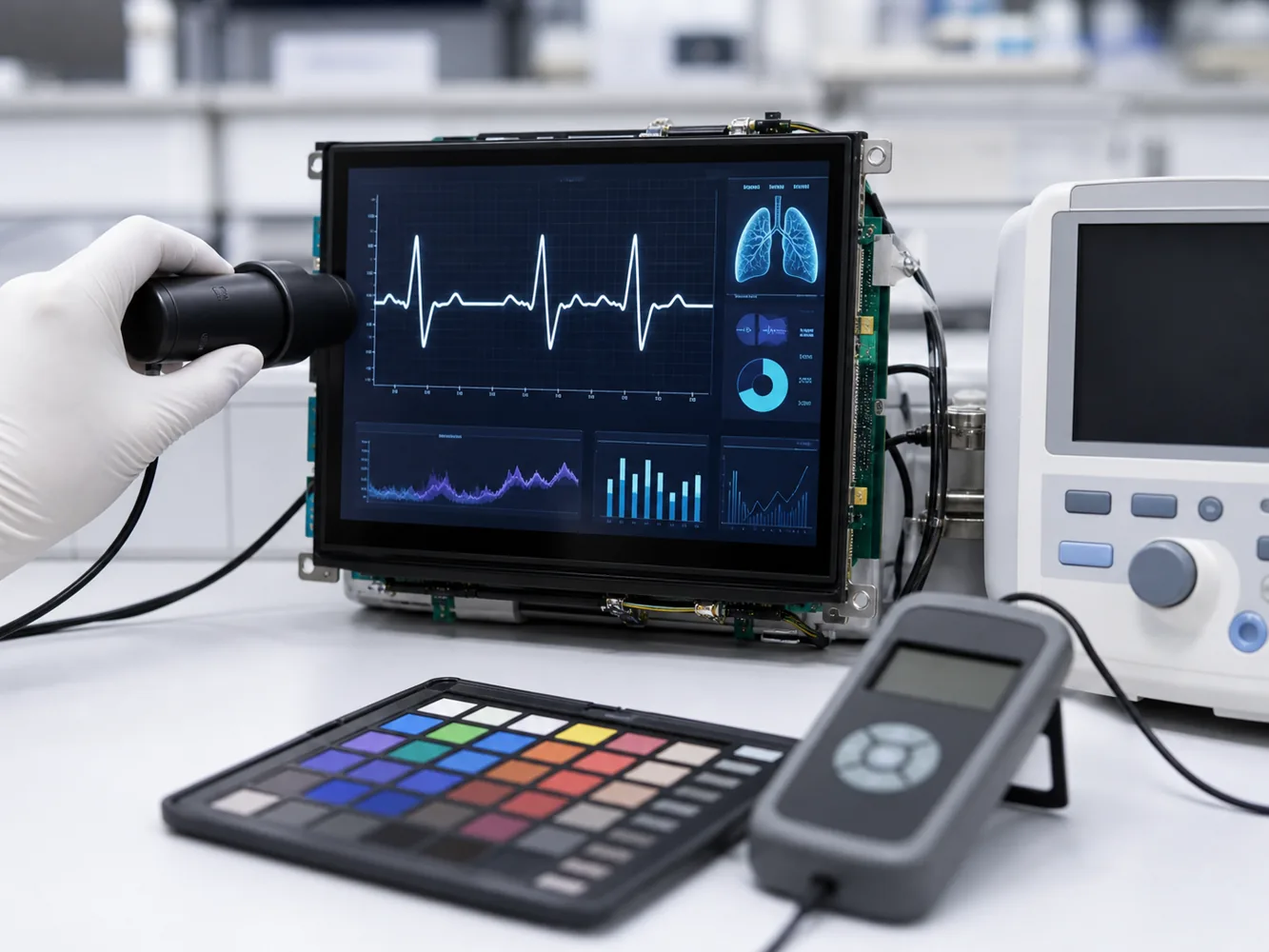 Brightness, contrast, color consistency, and viewing angle should be validated with real medical UI content.
For devices viewed from the side or from standing and seated positions, IPS TFT LCD modules can help improve viewing angle and color stability. This is useful when several users may view the screen at once or when the device is mounted on a cart, wall, or instrument panel.
For critical UI colors, confirm that warning colors, status indicators, and grayscale content remain distinguishable. If cover glass is used, test the full optical stack, not only the open LCD sample.
4. Consider Touch Operation and Cleaning
Many medical devices use touch interfaces to reduce buttons and simplify operation. However, touch design must consider gloves, cleaning liquids, cover glass thickness, grounding, ESD protection, and enclosure sealing.
Capacitive touch can provide a modern interface, but the actual touch performance should be tested with the real cover lens, housing, and operating conditions. Review capacitive touch TFT LCD modules if your product needs integrated touch operation.
If the device is frequently cleaned, the cover material, coating, gasket, bonding method, and edge sealing should be reviewed early. Touch performance and optical readability should both be validated after mechanical integration.
5. Validate Mechanical Integration
The LCD module must fit the enclosure without stress on the glass, FPC, connector, or touch panel. Medical device housings often need clean surfaces, sealed edges, and reliable assembly methods.
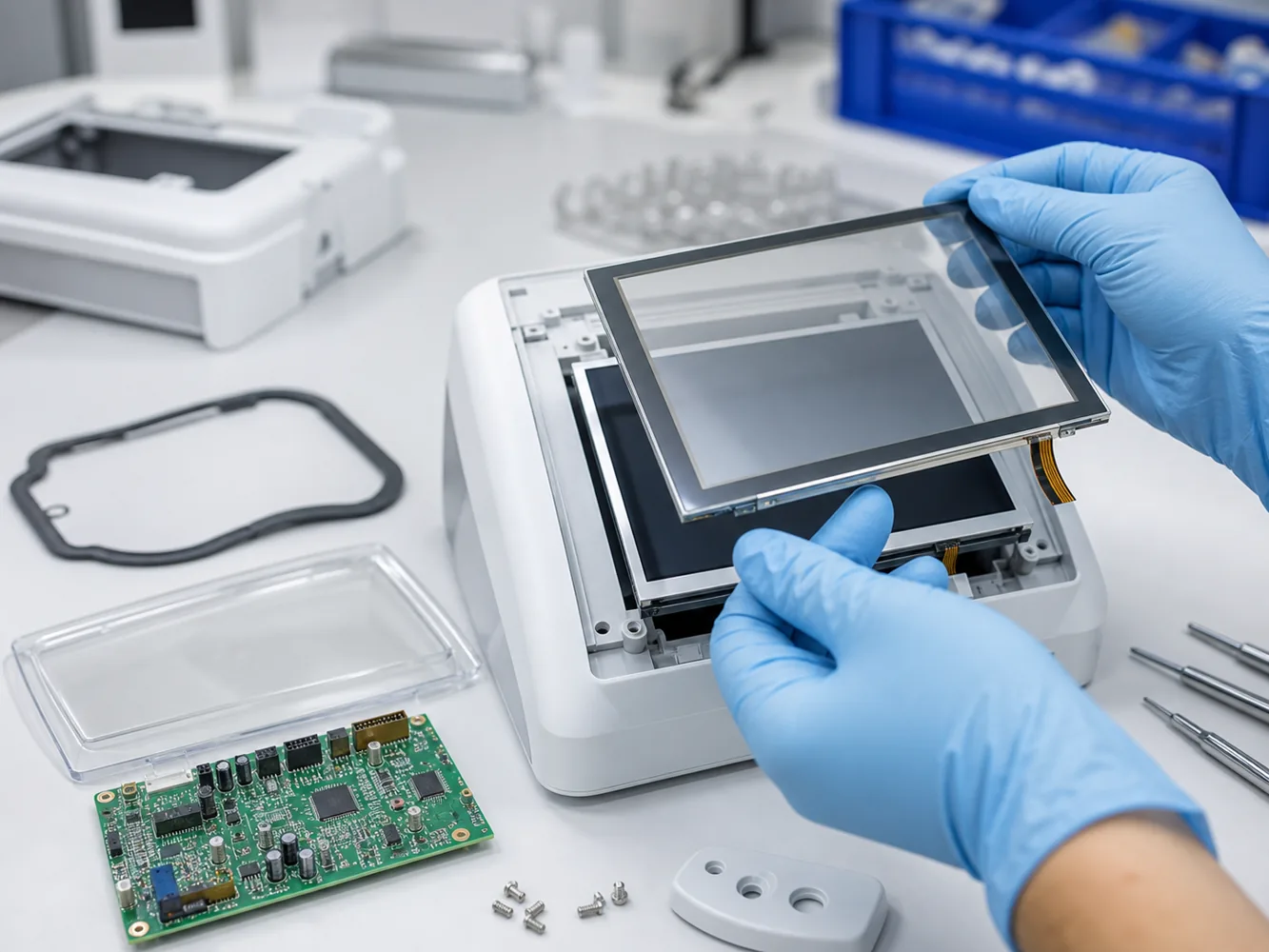 Cover glass, touch sensitivity, cleaning process, and enclosure sealing should be reviewed together.
Review active area, outline size, thickness, mounting method, FPC exit direction, connector type, cable routing, cover glass overlap, and gasket pressure. Avoid designs that force sharp FPC bends or transfer enclosure pressure to the LCD glass.
If optical bonding is needed to improve readability or mechanical robustness, confirm bonding feasibility, cover glass design, and inspection requirements before finalizing the enclosure.
6. Check Operating Temperature and Reliability
Medical devices may operate in hospitals, clinics, laboratories, ambulances, or home-care environments. Temperature, humidity, cleaning process, vibration, storage conditions, and daily usage time can all affect display reliability.
For equipment that may face wider operating conditions, review wide temperature TFT LCD modules and validate display behavior across the target range.
Reliability review should include backlight lifetime, voltage compatibility, ESD protection, EMI behavior, packaging, incoming inspection, and long-term supply. Medical products often have longer approval and service cycles, so display lifecycle matters.
7. Plan Supply Stability and Change Control
For medical device programs, a display change can trigger mechanical, electrical, optical, firmware, and regulatory review. Buyers should therefore evaluate lifecycle, lead time, MOQ, change notification process, and alternative planning before mass production.
Ask the supplier for datasheet, drawing, interface details, optical data, touch information, backlight parameters, packaging method, and expected lifecycle. For custom cover glass, FPC, bonding, or touch designs, confirm engineering support and production control early.
Practical Buying Checklist
Before approving a medical device LCD module, review these points:
- Application type and real user workflow
- Screen size, active area, and enclosure fit
- Resolution and medical UI readability
- Brightness, contrast, viewing angle, and color consistency
- Touch requirement, glove use, and cleaning process
- Cover glass, coating, bonding, and sealing
- Interface, voltage, and processor compatibility
- Operating temperature and reliability target
- Backlight lifetime and power consumption
- Lifecycle, traceability, MOQ, and change control
How Sunshine Display Can Help
Sunshine Display supplies LCD display modules up to 32 inches for global B2B customers. For medical device projects, Sunshine Display can help review size, resolution, brightness, viewing angle, touch panel, cover glass, interface, FPC, connector, optical bonding, operating temperature, packaging, and sample validation requirements.
If you are developing a diagnostic instrument, monitor, therapy device, laboratory analyzer, or medical control panel, share your application, target size, UI requirements, interface, touch needs, enclosure design, cleaning conditions, operating environment, and expected volume. You can contact Sunshine Display to discuss suitable LCD display module options before finalizing your product design.
FAQ
What size LCD module is suitable for medical devices?
The right size depends on UI complexity, viewing distance, enclosure design, and workflow. Medical devices may use compact, medium, or larger display modules depending on the application.
Are IPS LCD modules useful for medical equipment?
Yes. IPS modules can improve viewing angle and color stability, which helps when users view the screen from different positions.
Should medical device displays use capacitive touch?
Capacitive touch is useful for modern interfaces, but glove use, cleaning process, cover glass thickness, and ESD requirements must be tested.
Why is lifecycle important for medical LCD modules?
Medical devices often have long approval and service cycles. A display change can create extra validation work, so stable supply and change control matter.
Can Sunshine Display support medical LCD display projects?
Yes. Sunshine Display can help review LCD size, resolution, touch, cover glass, brightness, interface, reliability, and sample validation needs for medical device projects.