EV Charging Station LCD Display Module Guide
EV charger displays should be selected around outdoor readability, touch operation, sealing, and long-term reliability.
EV charging stations need display modules that remain readable, reliable, and easy to operate in outdoor or semi-outdoor environments. The LCD module is not only a screen; it is part of the payment flow, user guidance, charging status display, safety messaging, maintenance interface, and brand experience.
For OEM buyers, product managers, and engineers, the display decision should consider brightness, reflection, viewing angle, touch performance, cover glass, sealing, temperature range, interface, power consumption, and long-term supply. Sunshine Display supports LCD display modules up to 32 inches for EV charging, industrial, medical, commercial, and embedded equipment.
This guide explains how to select an LCD display module for EV charging stations with practical reliability and purchasing considerations.
1. Define the Charger Display Use Case
An EV charging station display may be used for charging instructions, QR code or payment guidance, plug status, energy data, fault messages, advertising, and maintenance menus. A small status display, a medium-size touch screen, and a larger commercial panel have different requirements.
Before choosing the display, define where the charger will be installed: indoor parking garage, outdoor roadside station, commercial plaza, fleet depot, residential community, or highway service area. Lighting, temperature, rain exposure, user distance, and operation time all influence the LCD module structure.
If users need to read instructions quickly in public environments, the UI should be tested on the real display, not only on a computer monitor.
2. Choose Size, Resolution, and Aspect Ratio Together
Screen size should match the charging workflow. A compact display may be enough for status and basic prompts, while a larger panel may be needed for payment flow, multilingual instructions, advertising, or richer UI.
Resolution affects readability and UI density. A low-resolution display can make icons, QR codes, and small text difficult to read. A high-resolution module can improve user experience, but it also affects interface bandwidth, processor requirements, and cost.
If your team needs a mature baseline, standard TFT LCD modules can be used to compare size, resolution, interface, and mechanical fit before moving into customized cover glass or bonding.
3. Prioritize Sunlight Readability
Outdoor and semi-outdoor EV chargers face strong ambient light, reflections, and changing viewing angles. Brightness alone does not guarantee readability. Contrast, cover glass reflection, anti-glare surface, optical bonding, viewing angle, and UI color design all matter.
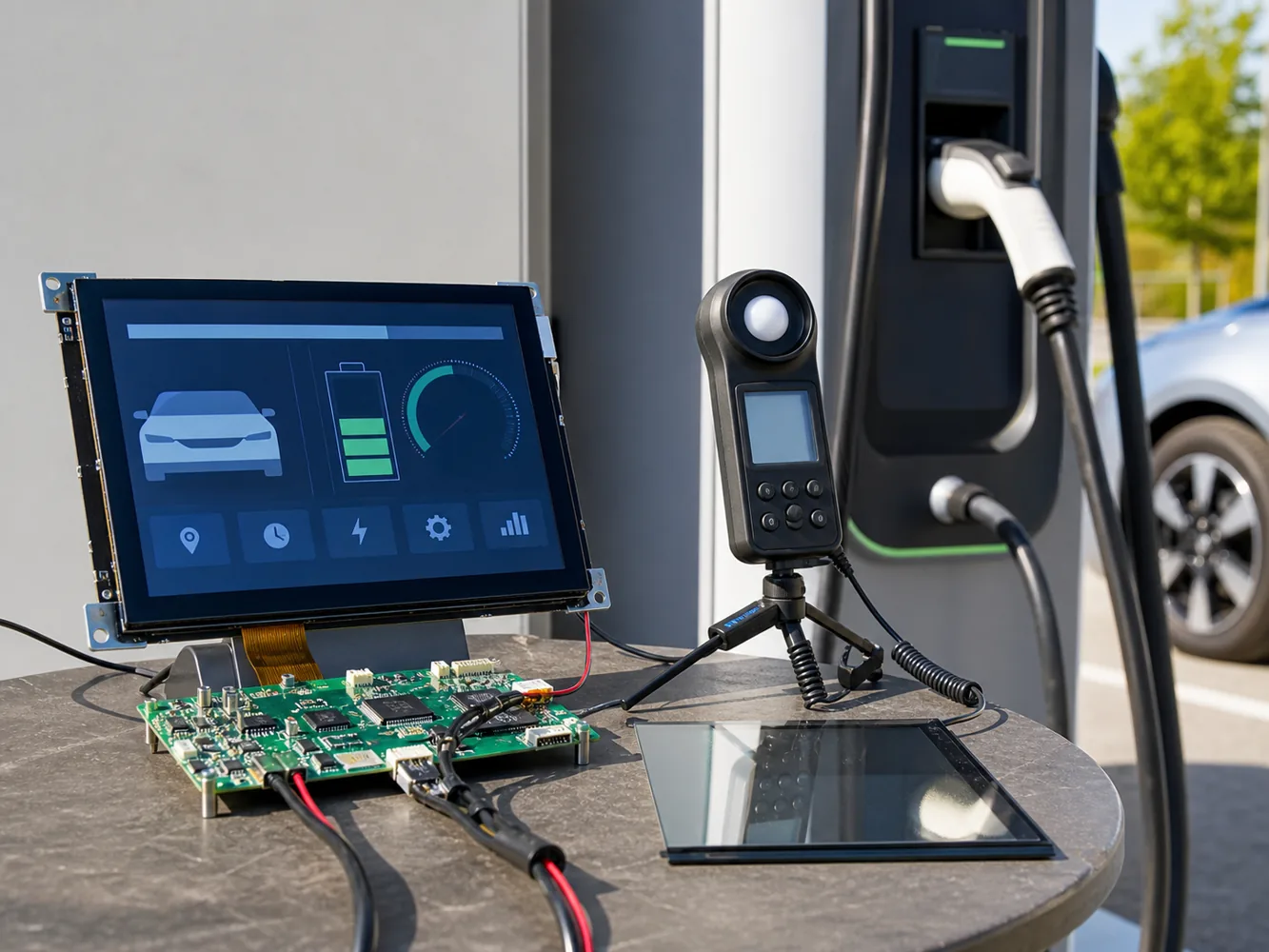 Outdoor charger displays should be tested with real brightness, reflection, cover glass, and UI conditions.
For charger screens viewed from standing positions or side angles, IPS TFT LCD modules can help maintain color and contrast stability. For bright environments, high brightness should be combined with optical design rather than treated as a single specification.
Test the display with actual charger UI screens, including QR codes, warning messages, charging progress, error states, and idle screens. Reflections from cover glass and the charger housing should be checked in the final mechanical structure.
4. Review Touch Panel and Cover Glass Design
Many EV chargers use touch screens for operation, but public outdoor touch design is more demanding than indoor touch design. Users may operate the screen with wet fingers, gloves, or dirty hands. The display may also face rain, cleaning, vandalism risk, and ESD events.
If touch is required, review capacitive touch TFT LCD modules together with cover lens thickness, touch controller, grounding, edge sealing, ESD protection, and firmware tuning.
The cover glass should be reviewed for thickness, strength, surface treatment, printing, adhesive, bonding, and mechanical support. The touch panel should be tested after integration into the real charger enclosure.
5. Consider Sealing, Temperature, and Outdoor Reliability
EV charger displays may operate in hot sun, cold mornings, rain, dust, and continuous public use. The LCD module, touch panel, cover glass, FPC, connector, backlight, and enclosure sealing should be reviewed together.
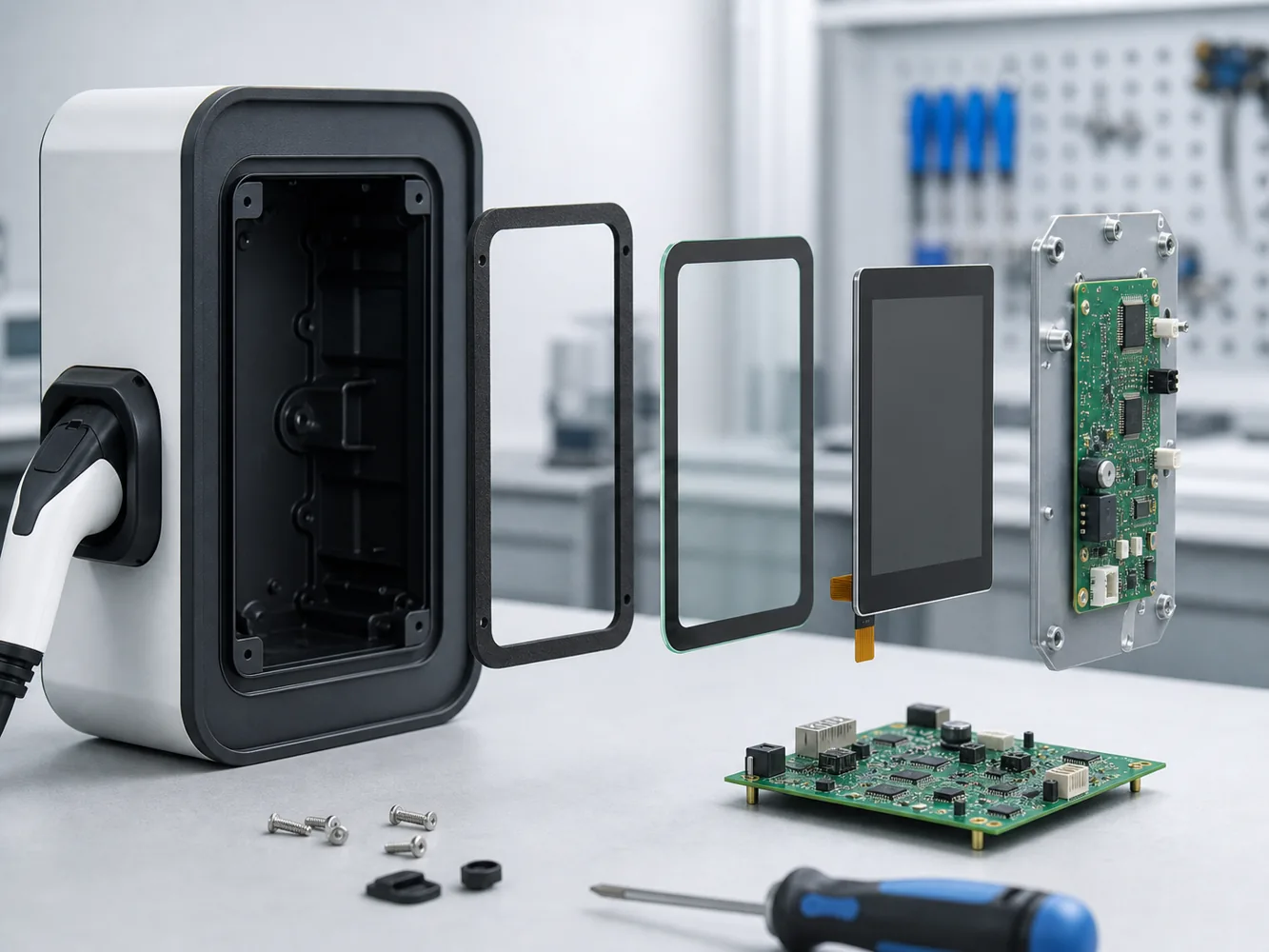 Cover glass, gasket, touch panel, LCD module, and enclosure design should be reviewed as one system.
For harsh environments, wide temperature TFT LCD modules may be required. Validate startup, touch response, brightness, display uniformity, and image stability across the expected temperature range.
Backlight lifetime is also important. Outdoor displays may use higher brightness, which increases thermal load and power consumption. The thermal design of the charger housing should support long-term display reliability.
6. Match Interface and System Architecture
The display interface should match the charger controller, operating system, and UI performance requirement. Common options include RGB, LVDS, MIPI DSI, HDMI-related display boards, and other embedded interfaces depending on module size and system design.
For larger screens, cable length, shielding, EMI, connector locking, and grounding become more important. For touch displays, the touch interface and display interface should be validated together.
Before approving samples, confirm voltage compatibility, backlight driver requirements, initialization support, touch controller support, and firmware resources. A good display choice should simplify mass production, not only pass a one-time demo.
7. Plan Lifecycle and Maintenance
EV charging equipment often has a long service life. Replacing a display after field deployment can be costly, especially if the front housing, cover glass, firmware, or regulatory documentation is affected.
Buyers should check lifecycle status, lead time, MOQ, packaging, inspection standards, and change notification process. For charger networks, consistency across batches matters because units may be installed in many locations over several years.
Practical Buying Checklist
Before approving an EV charger LCD display module, review these points:
- Installation environment and lighting condition
- Screen size, active area, and UI complexity
- Resolution, aspect ratio, and QR code readability
- Brightness, contrast, and viewing angle
- Cover glass reflection, AG treatment, or optical bonding
- Touch performance with wet fingers or gloves
- Sealing, gasket pressure, and enclosure integration
- Operating temperature and backlight lifetime
- Interface, voltage, connector, and cable routing
- Lifecycle, MOQ, lead time, and change control
How Sunshine Display Can Help
Sunshine Display supplies LCD display modules up to 32 inches for global B2B customers. For EV charging station projects, Sunshine Display can help review display size, brightness, viewing angle, touch panel, cover glass, optical bonding, interface, operating temperature, FPC, connector, and sample validation requirements.
If you are developing AC chargers, DC fast chargers, wallbox products, commercial charging terminals, or outdoor payment interfaces, share your application, target size, UI requirements, interface, touch needs, enclosure design, operating environment, and expected volume. You can contact Sunshine Display to discuss suitable LCD display module options before finalizing your charger design.
FAQ
What LCD brightness is suitable for EV charging stations?
It depends on the installation environment. Outdoor and semi-outdoor chargers often need higher brightness plus optical design such as anti-glare cover glass or optical bonding.
Are IPS LCD modules useful for EV charger displays?
Yes. IPS modules can improve viewing angle and color stability, which helps users read the display from standing and side positions.
Should EV charger displays use capacitive touch?
Capacitive touch is common, but wet fingers, gloves, ESD, cover glass thickness, and enclosure grounding should be tested in the final product.
Why is wide temperature important for EV charger LCD modules?
Outdoor chargers may face hot sun, cold starts, and large temperature changes, so the LCD module should be validated across the expected operating range.
Can Sunshine Display support EV charger LCD projects?
Yes. Sunshine Display can help review LCD size, brightness, touch panel, cover glass, optical bonding, interface, operating temperature, and reliability requirements.