What Makes an LCD Module Ready for Mass Production
Moving an LCD display module from sample approval to mass production is a separate engineering stage. A sample can look good on the bench, but production readiness means the module, drawing, touch panel, backlight, cable, packaging, test method, and supply plan are all controlled well enough for repeated OEM builds.
For companies sourcing LCD display modules up to 32 inches, this step is especially important because product sizes and applications vary widely. A handheld controller, a smart home terminal, an industrial HMI, a medical device, and a commercial display may all use TFT LCD modules, but the risks before mass production are not identical.
Mass production readiness means the approved LCD module, drawing, BOM, test criteria, and change control process are aligned.
Start With a Clear Approved Sample
The approved sample should be more than a working screen. It should represent the exact specification that purchasing, engineering, quality, and production teams agree to use. That includes LCD size, resolution, interface, brightness, viewing direction or IPS type, touch structure, cover glass, FPC length, connector model, operating temperature, and packaging method.
If the project uses a standard module, compare the approved sample with the selected product family on Sunshine Display's LCD display module product page. If the design uses a common TFT platform, the standard TFT LCD modules category can help buyers and engineers compare size, resolution, and interface options before confirming the production version.
A common mistake is approving a prototype without recording small changes. For example, the first sample may use a temporary FPC, a different backlight cable, a different touch controller firmware, or a test connector. These differences should be closed before volume orders begin.
Freeze the Drawing and Critical Dimensions
Mass production needs a controlled drawing. The drawing should define the outline dimensions, active area, viewing area, total thickness, connector position, FPC route, mounting holes or frame structure, touch panel stack, and tolerances. If the LCD module will be installed behind a bezel or cover lens, the mechanical team should confirm that the enclosure does not block the active area or apply pressure to the glass.
For larger modules, flatness, bracket support, and transportation protection become more important. For smaller modules, connector clearance and assembly sequence often create the most trouble. In both cases, the mechanical drawing should match the real enclosure, not only the electrical development board.
Confirm the BOM Before Ordering Volume
The bill of materials should define the LCD cell, driver IC, backlight, polarizer, FPC, connector, touch sensor, cover glass, adhesive, and packaging accessories. Buyers should ask which parts are standard, which are customized, and which have long lead times.
This does not mean every component must be unique to the project. In many cases, choosing a proven standard platform is safer. But if the project needs high brightness, wide viewing angle, special touch glass, or wide temperature operation, those requirements should be locked into the production BOM.
For products where viewing angle and color stability matter, IPS TFT LCD modules may be a better fit than a basic TN display. For products used in cold storage, outdoor equipment, vehicles, or industrial environments, the team should review wide temperature TFT LCD modules early instead of treating temperature range as a late-stage upgrade.
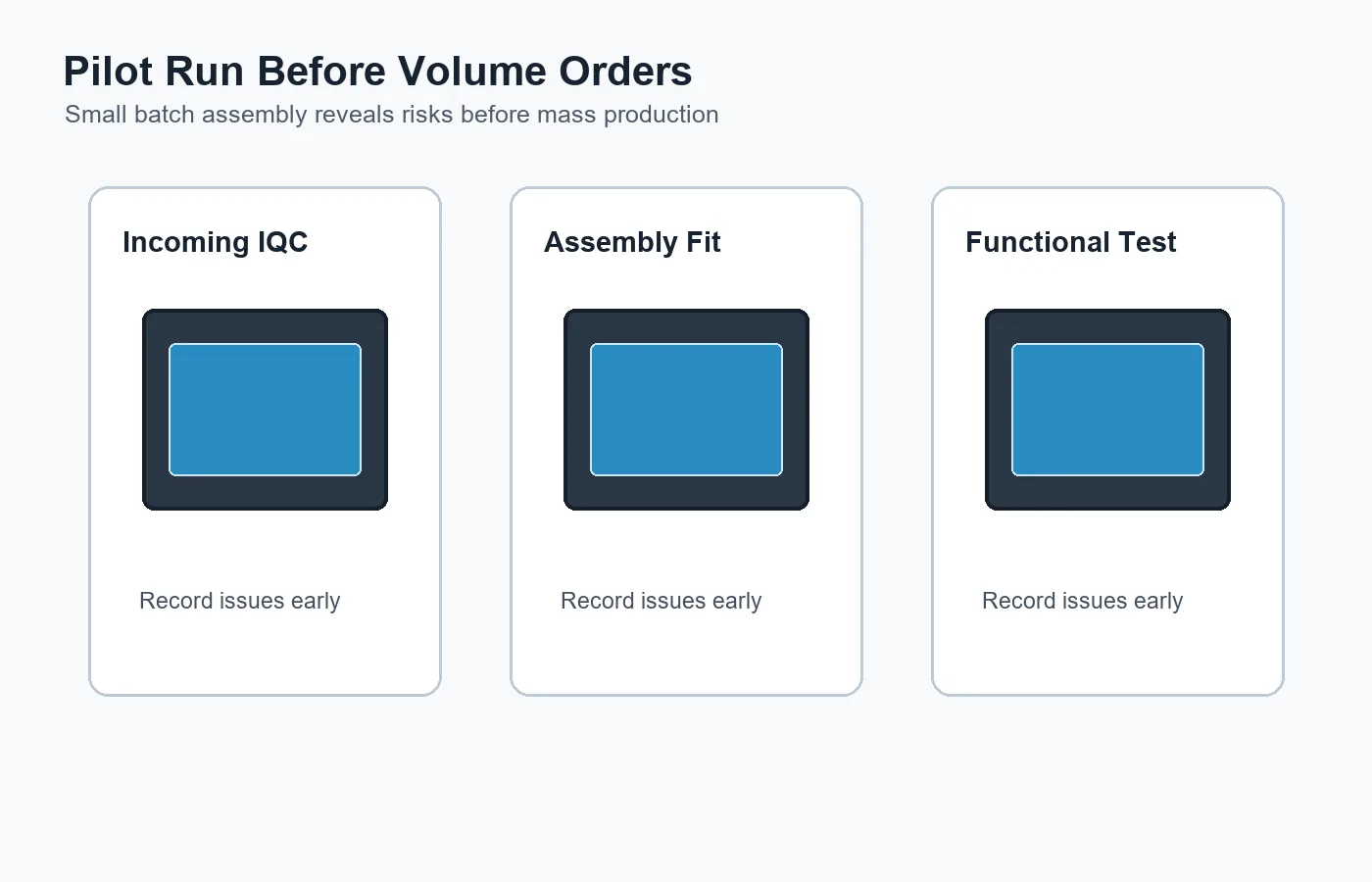 A pilot build checks enclosure fit, cable routing, assembly process, display readability, and touch operation before mass production.
Run a Pilot Build, Not Only a Bench Test
A pilot build is one of the most practical ways to find hidden risks. Instead of testing one sample on an engineer's desk, assemble a small batch using the real enclosure, cable route, touch panel, screws, gasket, adhesive, and production process.
During the pilot run, record whether the LCD fits smoothly, whether the FPC is easy to connect, whether operators can avoid scratches, whether the display remains readable after assembly, and whether the touch panel works reliably inside the finished product. If the module has a cover glass or projected capacitive touch, review the final user experience under real operating conditions. Sunshine Display's capacitive touch TFT LCD modules can support many OEM interface designs, but final validation should still include enclosure, grounding, and user operation tests.
Pilot production also checks communication between teams. Engineering may focus on drawings, purchasing on lead time, quality on inspection, and production on assembly speed. The display supplier should help connect these concerns into one practical production plan.
Define Incoming Quality Inspection
Before volume shipments, agree on incoming quality inspection criteria. The checklist may include visual inspection, display function, dead pixel criteria, brightness, color, touch function, connector condition, FPC appearance, label information, packaging condition, and sample retention.
The inspection method should be realistic. If criteria are too vague, factories may accept unstable quality. If criteria are too strict without being linked to actual product use, inspection becomes slow and expensive. A balanced standard should protect the final product while keeping production efficient.
For OEM buyers, it is useful to keep a golden sample and approved photos. These references make future communication faster when a factory, supplier, or customer reports an issue.
Control Changes After Approval
Once the production specification is approved, any change should be visible. This includes LCD cell, driver IC, backlight LED, FPC material, connector, touch IC, cover glass, adhesive, firmware, label, and packaging. Some changes may be harmless, but others can affect display timing, brightness, color, touch performance, EMI behavior, or mechanical fit.
The key is not to block every change forever. The goal is to review meaningful changes before they reach production. Buyers should ask the supplier how change notifications are handled and how alternative parts are qualified.
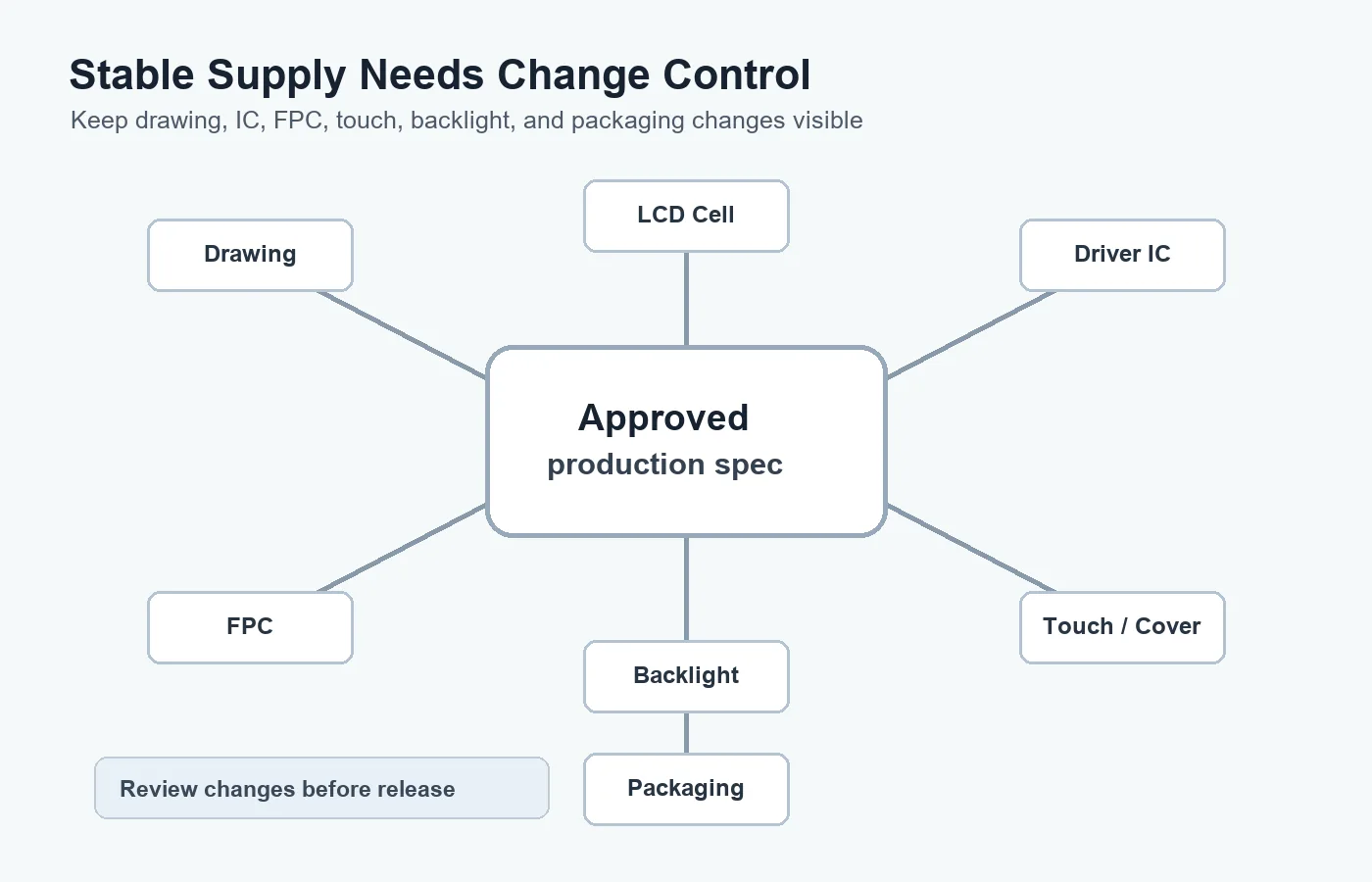 After approval, changes to key LCD module materials should be reviewed before they enter production.
Prepare the Ordering Plan
Production readiness also depends on demand planning. LCD module supply involves material purchasing, production scheduling, inspection, and logistics. If demand changes quickly, the supplier may need a forecast, buffer plan, or staged delivery schedule.
For customized modules, lead time can be affected by tooling, touch panel materials, cover glass printing, special backlight design, and qualification tests. For standard modules, lead time is usually simpler, but stable supply still depends on forecast accuracy and component availability.
Buying Advice for OEM Teams
Before placing a mass production order, ask your LCD supplier for an approved specification package: drawing, electrical interface notes, optical data, mechanical notes, touch details, packaging method, inspection criteria, and change control process. Also confirm whether the production sample is identical to the approved sample.
Sunshine Display supports TFT LCD modules for OEM applications, including small, medium-size, and larger industrial/color LCD display modules up to 32 inches. If your project is moving from sample approval to volume production, you can contact Sunshine Display to review the display specification, production risks, and supply plan before final ordering.
FAQ
When is an LCD module ready for mass production?
An LCD module is ready when the approved sample, drawing, BOM, test criteria, packaging, and change control process are confirmed. The module should also pass a pilot build in the real product enclosure.
Why is a pilot build important for LCD display modules?
A pilot build reveals practical assembly and reliability issues that may not appear during a bench test, such as cable routing, touch behavior, pressure marks, scratches, or enclosure fit problems.
Should the LCD module drawing be frozen before volume orders?
Yes. The drawing should be controlled before mass production so the enclosure, connector position, active area, touch stack, and tolerances match the approved design.
What should buyers ask before ordering production quantities?
Buyers should ask for the final drawing, approved sample status, BOM confirmation, inspection criteria, packaging method, lead time, and change notification process.
Can standard TFT LCD modules be used for mass production?
Yes. Standard TFT LCD modules are often suitable for volume production when their size, interface, brightness, temperature range, and lifecycle match the OEM product requirements.