Labeling equipment HMIs combine product selection, sensor state, speed, alarms, and service information at the packaging line.
Industrial labeling machines are used on packaging lines for bottles, containers, cartons, chemical products, food products, and industrial parts. The operator interface manages product selection, label position, conveyor speed, sensors, roll changes, alarms, counters, and maintenance. Selecting an LCD display for industrial labeling machines is a practical integration decision: the HMI needs to match the real workflow, enclosure, cleaning environment, control system, and lifecycle of the machine.
Sunshine Display supplies industrial display modules for OEM applications, including TFT LCD modules up to 32 inches and customized touch display assemblies. A reliable labeling-machine HMI begins by treating the LCD module, touch panel, controller, sensors, front cover, and cabinet mechanics as one product system.
Start With the Changeover and Production Workflow
The screen requirements vary by machine. A simple applicator may show run state, label count, sensor status, and a few adjustment pages. A high-speed wrapping, front-and-back, print-and-apply, or multi-station system may need recipe selection, conveyor synchronization, label length, product detection, vision inspection result, reject status, and detailed diagnostics.
Identify what each user needs. Operators need a clear run view and quick alarm recognition. Changeover personnel need the correct product parameters and label setup. Maintenance technicians need access to sensors, motors, drives, I/O, counters, and fault history. Use representative UI screens during display evaluation instead of a generic demonstration image.
The HMI should support the operation without replacing safety controls. Guard interlocks, emergency stops, and other protective functions belong in the machine safety architecture even if their state is shown on the display.
Choose Size and Viewing Performance for the Line
Screen size follows information density, mounting location, viewing distance, and controller capability. Compact modules work well on a local labeling head or standalone applicator. Medium and larger displays can reduce page switching on integrated packaging equipment where users manage several sensors, conveyors, printers, or inspection stations.
Review the active area, outer dimensions, mounting holes, bezel opening, cable exit, connector clearance, and service access. A narrow pedestal or stainless enclosure can restrict the space available behind the front panel. Protect FPCs and connectors from vibration, repeated door movement, and cable strain.
Operators may approach the panel from different sides of a conveyor. An IPS TFT LCD module can provide more stable contrast and color across wider viewing angles. Confirm the final result with the real protective window and the factory lighting around the machine.
Keep the HMI Readable During Production
The HMI must make the current condition obvious: is the machine running, is label stock low, has a sensor lost the product, is the applicator in position, or does a rejected product need attention? Use a clear hierarchy so the primary machine state and active alarm are easy to identify before secondary counters or setup fields.
Bright packaging lines can have reflective stainless guards, overhead lights, windows, and glossy materials. Brightness is only one part of readability. Evaluate contrast, viewing angle, surface reflection, cover-lens treatment, and the display angle where operators actually stand.
Do not use color alone for a critical alert. Combine it with a clear position, icon, or wording so operators can recognize the state under varied ambient light and during fast line operation.
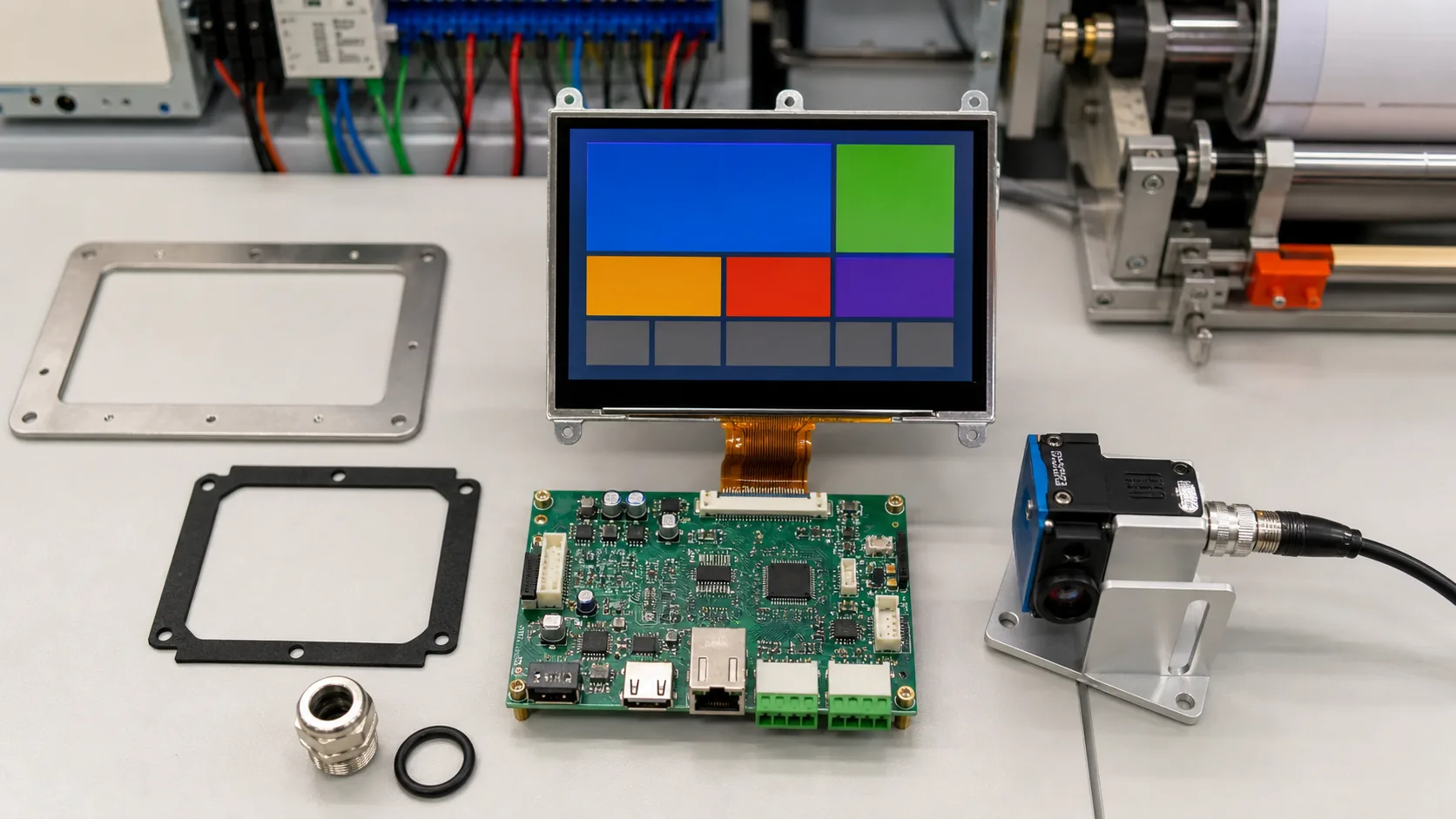 Display, touch, controller, label sensor, camera, enclosure, and cable routing should be engineered as one machine interface.
Design Touch and the Front Surface Together
Touch control can simplify recipe selection, guided changeovers, counter reset, and diagnostic navigation. A capacitive touch TFT LCD module can provide a sealed, cleanable front surface. It must still be tested with gloves, product residue, moisture, cleaning chemicals, metal enclosure grounding, and the final cover glass.
Use touch targets large enough for the expected operating conditions, with clear pressed and confirmation states. Protect actions that can affect production, such as recipe changes, applicator calibration, or rejected-product settings. Physical controls may be appropriate for rapid, deliberate commands.
The cover lens, printing, bonding, gasket, and enclosure opening influence both durability and touch performance. Mechanical changes made late in the project can require touch retesting, so the front stack should be agreed before firmware release.
Coordinate the Display With Sensors and Motion Control
Labeling equipment often combines photoelectric sensors, encoders, print engines, servos, pneumatic valves, motors, and vision systems. The display and touch interface should be planned with the controller architecture, graphics workload, cable length, and electrical layout. RGB, LVDS, MIPI, or another display interface may be suitable depending on the system.
Keep display and touch cables away from high-noise power paths where possible. Review shielding, grounding, connector retention, and the return-current path. A clear recovery strategy also matters: after power loss, communication failure, or a printer error, the HMI should show its actual state and avoid presenting an old recipe or count as current.
Build for Cleaning, Vibration, and Lifecycle
Packaging equipment can experience washdown-adjacent cleaning, dust, label adhesive residue, vibration, and frequent access for roll changes. The enclosure, front cover, gasket, cable entry, mounting, and connector arrangement must handle the expected conditions. A capable display module will not compensate for an enclosure that allows contamination to reach the electronics.
Temperature near motors, drives, printers, and enclosed cabinets can also affect the display and backlight. For demanding sites, review wide-temperature TFT LCD modules along with brightness and backlight-lifetime requirements.
Ask about module lifecycle, compatible alternatives, change notification, and controller supply early. A stable supply plan supports labeling equipment that may remain in service for many years.
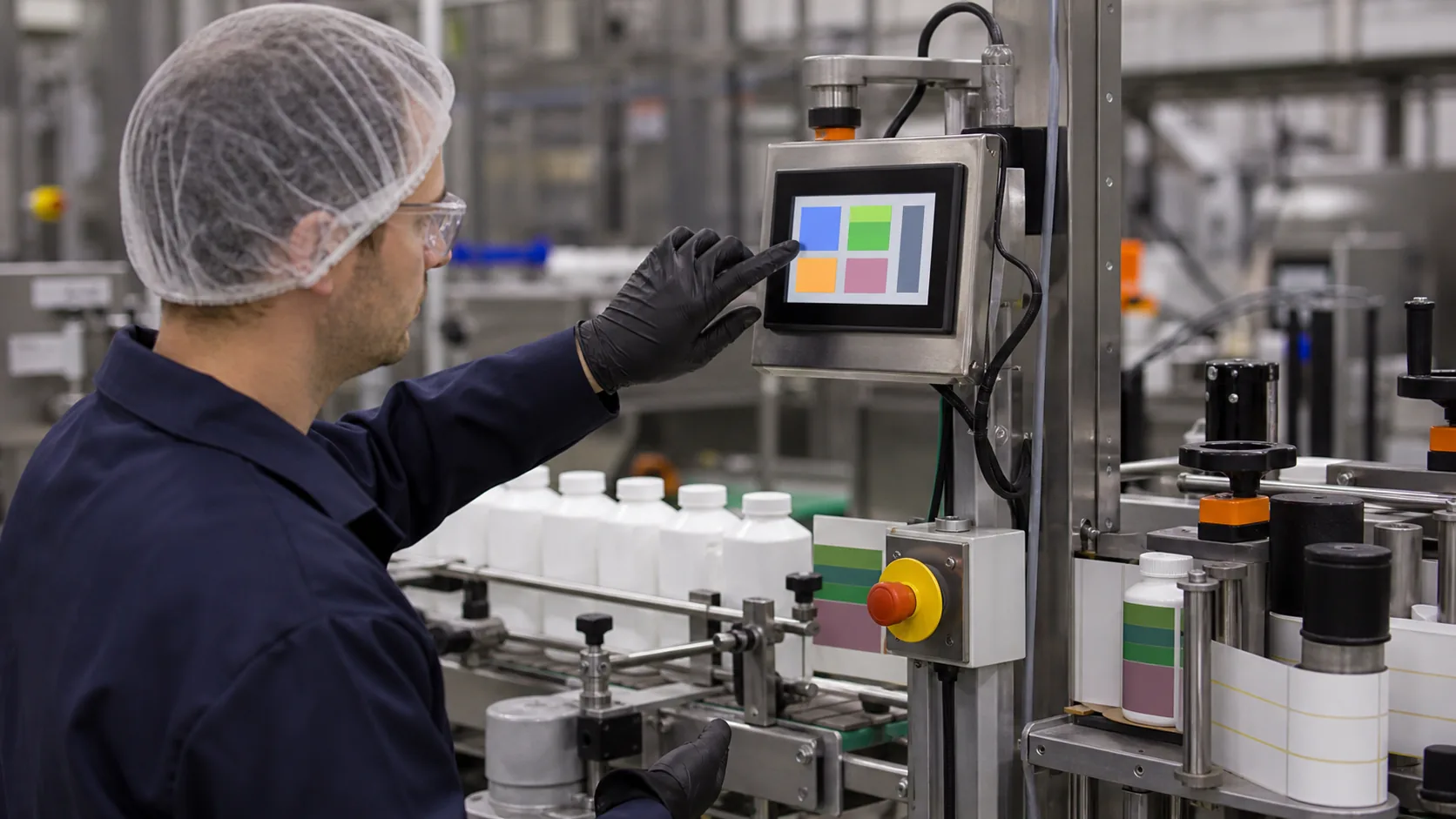 Production validation should include real label materials, sensor alignment, cleaning, glove use, and operator workflow.
Validate on a Representative Machine
Bench testing verifies basic function, but the real machine reveals operator and integration issues. Test with representative label materials, product containers, speed changes, sensor alignment, lighting reflections, final grounding, vibration, cleaning, gloves, startup, and fault recovery.
Watch operators perform a normal run, a label-roll change, a recipe selection, and an alarm response. They should quickly find the relevant state and the next permitted action. Capture unclear screens or touch failures before pilot production, while hardware, software, and mechanics can still be refined together.
Practical RFQ Checklist
Provide the machine application, display size, active area, resolution, brightness target, viewing direction, interface, touch requirement, front-cover concept, operating temperature, enclosure drawing, mounting, annual quantity, and lifecycle requirement. Representative UI screens and cable constraints allow a more accurate display recommendation.
Sunshine Display can review TFT LCD modules and custom HMI display assemblies for industrial labeling equipment. Contact Sunshine Display to discuss your label applicator, print-and-apply machine, or packaging-line display project.
FAQ
What should a labeling machine HMI display?
Typical screens show product or recipe selection, label roll state, speed, sensor and applicator status, alarms, counters, changeover steps, and maintenance diagnostics.
Why does touch testing matter on packaging equipment?
Operators may wear gloves and work around moisture, product residue, cleaning chemicals, and grounded metal equipment. The final touch stack must be validated under those conditions.
Is IPS useful for labeling machine displays?
IPS TFT LCD technology can help maintain color and contrast when operators view the HMI from different positions along a conveyor or packaging line.