LCD Display Module Interface Board Selection Guide
Interface board selection affects display bring-up, signal compatibility, firmware effort, and production risk.
An LCD display module may be electrically correct, mechanically suitable, and optically impressive, but the project can still slow down if the interface board is not selected carefully. For OEM teams, the interface board affects display bring-up, signal conversion, power design, touch support, firmware effort, EMC behavior, and final product reliability.
Sunshine Display supplies LCD display modules up to 32 inches for industrial, medical, EV charging, commercial, and embedded applications. Depending on the product architecture, customers may use a raw TFT LCD module with their own mainboard, a display module plus adapter board, or a complete controller board solution.
This guide explains how buyers, engineers, and product managers should evaluate LCD interface boards before sample approval and mass production.
1. Define the System Architecture First
The best interface board depends on the product architecture. A Linux-based HMI, Windows industrial panel, embedded MCU product, Android terminal, medical instrument, and EV charger may all need different display connection methods.
Before choosing a board, define the host processor, operating system, display size, resolution, refresh requirement, touch requirement, available connectors, power rails, enclosure space, and expected production volume.
If your team is still comparing display options, start with standard TFT LCD modules to review common sizes, resolutions, and interfaces.
2. Understand Common Interface Board Types
LCD interface boards can serve different roles. Some boards convert HDMI or USB-C style video input to the panel interface. Others adapt RGB, LVDS, MIPI DSI, or eDP signals. Some are designed only for evaluation, while others are suitable for production.
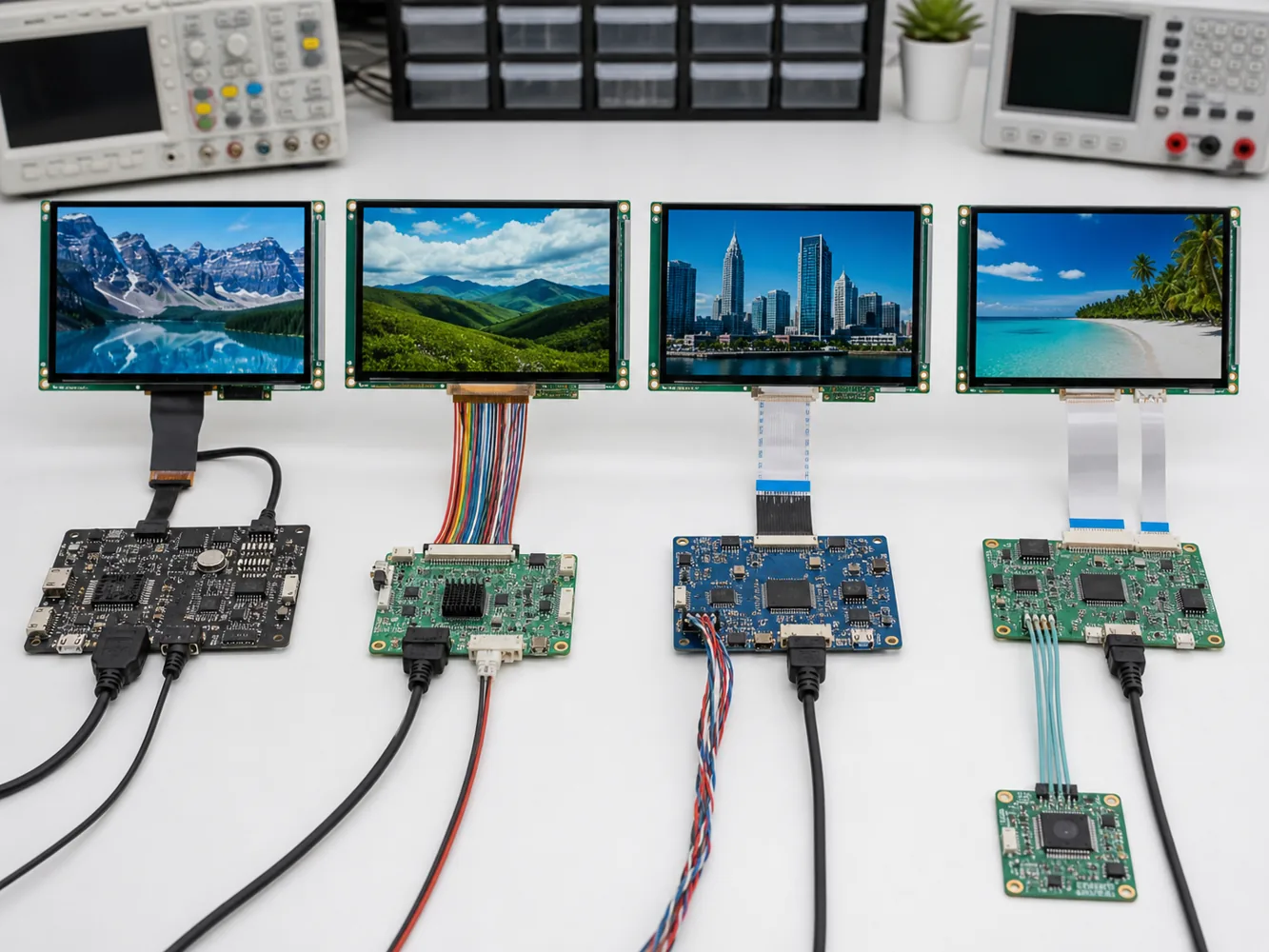 Different controller boards and signal interfaces suit different display sizes, processors, and product architectures.
For quick demos, an off-the-shelf controller board may be useful. For mass production, the board should be reviewed for component lifecycle, power stability, connector locking, EMC behavior, firmware control, mechanical fit, and long-term availability.
A display interface board is not just a cable adapter. It can include timing control, power sequencing, backlight driving, touch interface routing, button control, OSD settings, and protection circuits.
3. Match Interface, Resolution, and Refresh Needs
Resolution and interface bandwidth should be reviewed together. A low-resolution display can work with simpler interfaces, while a higher-resolution module may require LVDS, MIPI DSI, eDP, or another higher-bandwidth solution.
For products using rich graphics, trend charts, video, or smooth animations, the host system and interface board must support the required frame rate and color depth. If the interface board is under-specified, the display may flicker, show artifacts, fail initialization, or limit UI performance.
For applications requiring stable color and viewing angle, IPS TFT LCD modules should be evaluated together with the interface solution because the final display behavior depends on both panel and drive configuration.
4. Review Power and Backlight Design
Many interface boards handle more than signal conversion. They may also provide panel power, logic voltage, backlight current, dimming control, and power sequencing. These functions should be checked against the LCD module datasheet.
Do not assume that every board can safely drive every display with a similar connector. The backlight current, LED string voltage, panel logic voltage, and reset sequence may differ.
For battery-powered, industrial, or thermally constrained products, confirm backlight efficiency, brightness control, standby behavior, and thermal rise. The board should support the final product's power budget, not only a bench demo.
5. Include Touch Panel Requirements
If the display uses capacitive touch, the interface board may need to route USB, I2C, interrupt, reset, and power signals for the touch controller. Touch firmware and operating system driver support should be confirmed early.
For projects with touch operation, review capacitive touch TFT LCD modules together with cover glass, grounding, ESD protection, and touch controller compatibility.
Touch issues can appear only after enclosure integration. Cover glass thickness, metal frame design, cable routing, electrical noise, and grounding can all affect performance.
6. Test With the Real Enclosure and Cable Routing
Bench testing is useful, but it is not enough. The final enclosure changes cable length, bend radius, grounding, heat dissipation, and EMI exposure. The interface board should be validated inside the real mechanical structure.
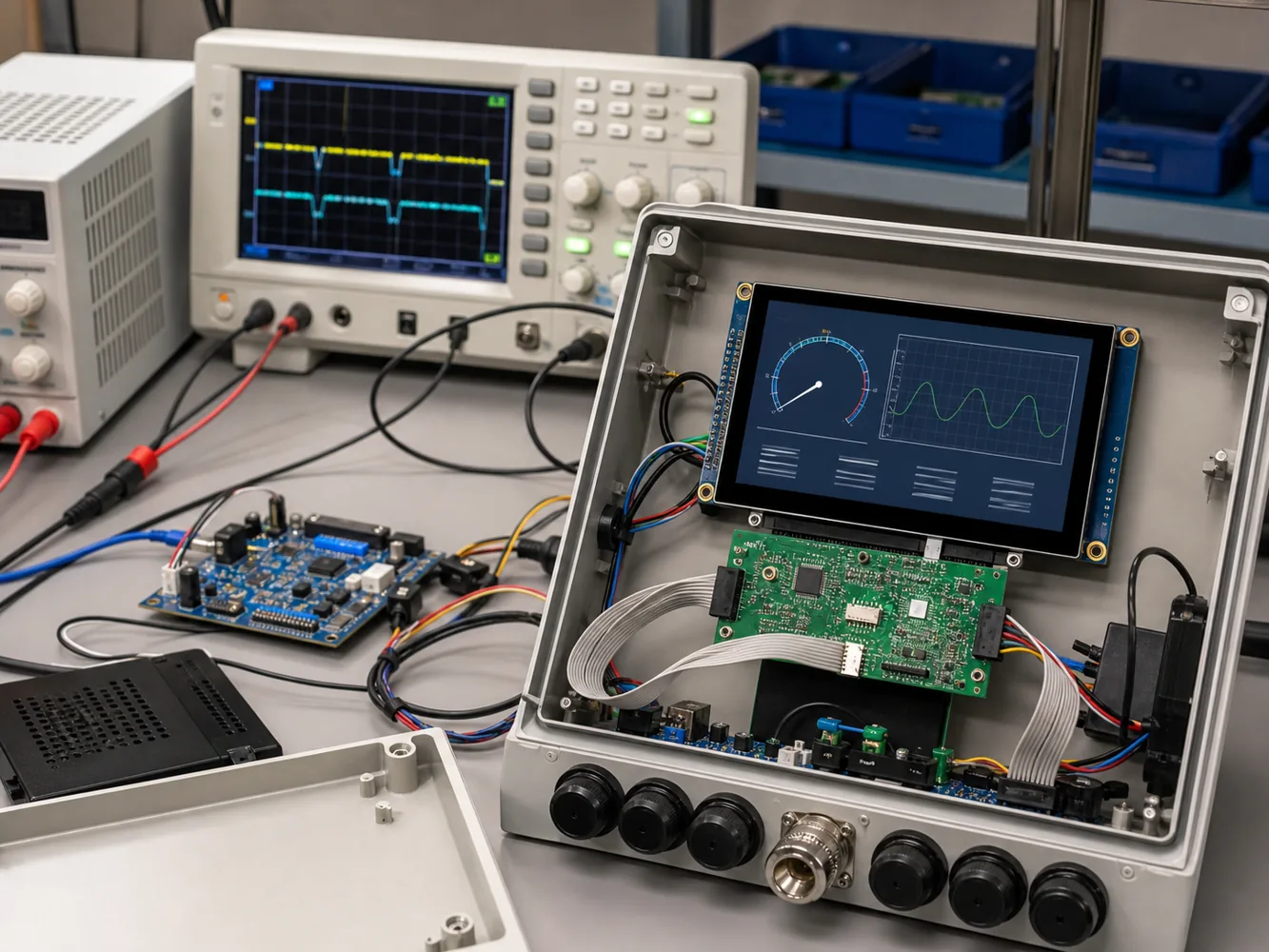 The interface board should be tested with the real enclosure, cable routing, power supply, and final UI workload.
For industrial or outdoor products, check whether wide temperature TFT LCD modules and wide-temperature interface components are needed. A panel may support the required temperature range, but the controller board components must also be suitable.
Test startup, sleep/wake, brightness adjustment, touch operation, ESD events, temperature range, power cycling, and long-duration operation.
7. Decide Between Evaluation Board and Production Board
Evaluation boards are useful for software development and early display testing. However, they may not be optimized for cost, size, connector retention, lifecycle, or mechanical installation.
For production, buyers should check whether the board design can be customized, whether BOM components are stable, whether firmware is controlled, and whether documentation is available.
If the final product already has a capable mainboard, it may be better to integrate the display interface directly into the mainboard. If the team wants faster development or lower software risk, a dedicated interface board may reduce engineering workload.
Practical Buying Checklist
Before approving an LCD display module interface board, review these points:
- Host processor and operating system
- Display size, resolution, and refresh target
- Required interface: RGB, LVDS, MIPI DSI, eDP, HDMI-related board, or others
- Panel voltage, logic level, and backlight current
- Touch interface and driver support
- Connector type, cable length, and locking method
- Power sequencing and reset timing
- Brightness dimming method
- EMC, ESD, grounding, and shielding
- Lifecycle, BOM stability, and production support
How Sunshine Display Can Help
Sunshine Display supplies LCD display modules up to 32 inches for global B2B customers. For interface board projects, Sunshine Display can help review display size, resolution, interface, driver IC, FPC, connector, touch panel, cover glass, optical bonding, backlight, operating temperature, and sample validation requirements.
If you are developing an industrial HMI, medical device, EV charger, commercial terminal, or embedded display system, share your host platform, display size, interface plan, touch requirement, enclosure design, power conditions, and expected volume. You can contact Sunshine Display to discuss suitable LCD display module and interface board options before finalizing your design.
FAQ
What is an LCD display module interface board?
It is a board that helps connect the host system to the LCD module, often handling signal conversion, power sequencing, backlight driving, and sometimes touch interface routing.
Can one interface board drive any LCD module?
No. The board must match panel resolution, timing, interface, voltage, backlight current, connector pinout, and sometimes driver IC requirements.
Is an evaluation board suitable for mass production?
Not always. Evaluation boards are useful for testing, but production boards should be reviewed for lifecycle, cost, mechanical fit, EMC, and component stability.
Does the interface board affect touch performance?
Yes. Touch power, signal routing, grounding, driver support, and electrical noise can all affect capacitive touch performance.
Can Sunshine Display support interface board selection?
Yes. Sunshine Display can help review LCD module interface, FPC, connector, touch panel, backlight, operating temperature, and integration requirements.