What Factory Automation LCDs Need to Survive Daily Use
Factory automation equipment is used every shift, not only during a product demo. Operators may read the screen under bright workshop lighting, touch the panel with gloves, clean the front surface, or monitor alarms while the machine is vibrating. For this reason, an industrial LCD module should be selected around the real operating environment, not only around size and price.
Sunshine Display focuses on LCD display modules for industrial and OEM applications, including small, medium-size, and larger color TFT LCD modules up to 32 inches. These modules are used in machine interfaces, test instruments, control terminals, automation equipment, measurement devices, and other professional systems where stability matters more than consumer-style appearance.
Factory automation LCD modules need stable readability, rugged integration, touch options, and long supply planning.
Readability Comes First in Industrial Use
In a factory, a display must be easy to read quickly. The user may not stand perfectly in front of the screen, and the interface may include alarm colors, numeric values, operating status, or small icons. A display that looks acceptable on a desk can become difficult to read after installation in a cabinet or machine frame.
Brightness, contrast, viewing angle, cover lens reflection, and UI color design should be reviewed together. If the product is used from multiple viewing positions, IPS TFT LCD modules may provide better viewing stability than a basic TN display. If the application is mostly indoor and cost-sensitive, standard TFT LCD modules may still be suitable when the user position is controlled.
Touch Panels Should Match Real Operators
Many industrial products now use touch screens, but industrial touch requirements are different from mobile phones. Operators may use gloves, touch the panel with dry or wet fingers, or clean the surface with alcohol or detergent. The device may also need a thicker cover lens or front gasket.
Projected capacitive touch can provide a clean front surface and modern operation. However, cover glass thickness, grounding, controller tuning, and enclosure design affect final touch performance. Sunshine Display's capacitive touch TFT LCD modules are relevant for OEM teams that need an integrated display and touch solution for control panels and equipment interfaces.
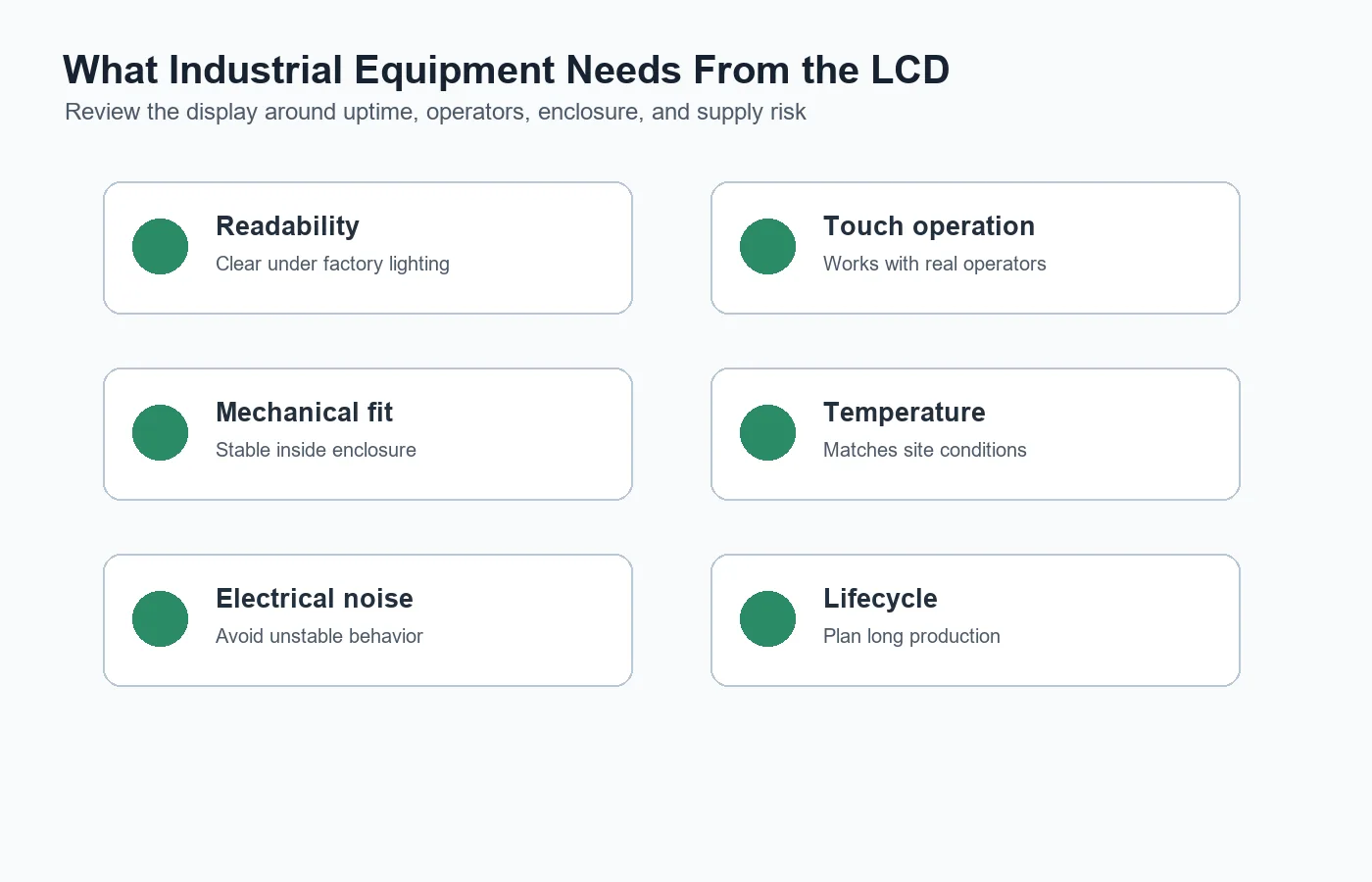 Industrial LCD selection should be based on operator visibility, touch behavior, enclosure fit, environment, electrical stability, and lifecycle.
Mechanical Fit Affects Reliability
Industrial LCD modules should be evaluated after the real enclosure is available. The active area, viewing area, outline size, FPC exit, connector position, gasket compression, and mounting structure all affect assembly quality. Poor mechanical design can create pressure marks, light leakage, cable damage, touch instability, or display misalignment.
For machines that operate for long periods, the module should be supported properly and protected from point pressure. Cable routing should allow a safe bend radius and should not be pinched by the housing or PCB. If the LCD will be mounted in a front panel, the bezel opening and cover lens mask should be checked against worst-case tolerance, not only nominal dimensions.
Temperature and Electrical Conditions Matter
Industrial equipment may be used near motors, power supplies, heaters, outdoor doors, cold storage areas, or control cabinets. Temperature range, power stability, EMI/EMC behavior, and ESD protection can all affect display reliability.
If the application faces cold, heat, or semi-outdoor conditions, review wide temperature TFT LCD modules early. A wide-temperature display does not remove the need for product-level validation, but it gives the engineering team a better starting point when the environment is demanding.
Test With the Final System
The most useful display test is not a loose LCD module on a bench. The module should be tested inside the actual product with the real cover lens, cable, PCB, power supply, enclosure, grounding, and software interface. This reveals issues that are easy to miss during sample approval.
Test white, black, gray, red, green, blue, fine text, warning colors, touch buttons, and actual operating screens. Check for readability from the expected operator positions. If the product will be used near electrical noise, motors, or long cables, include system-level testing before mass production.
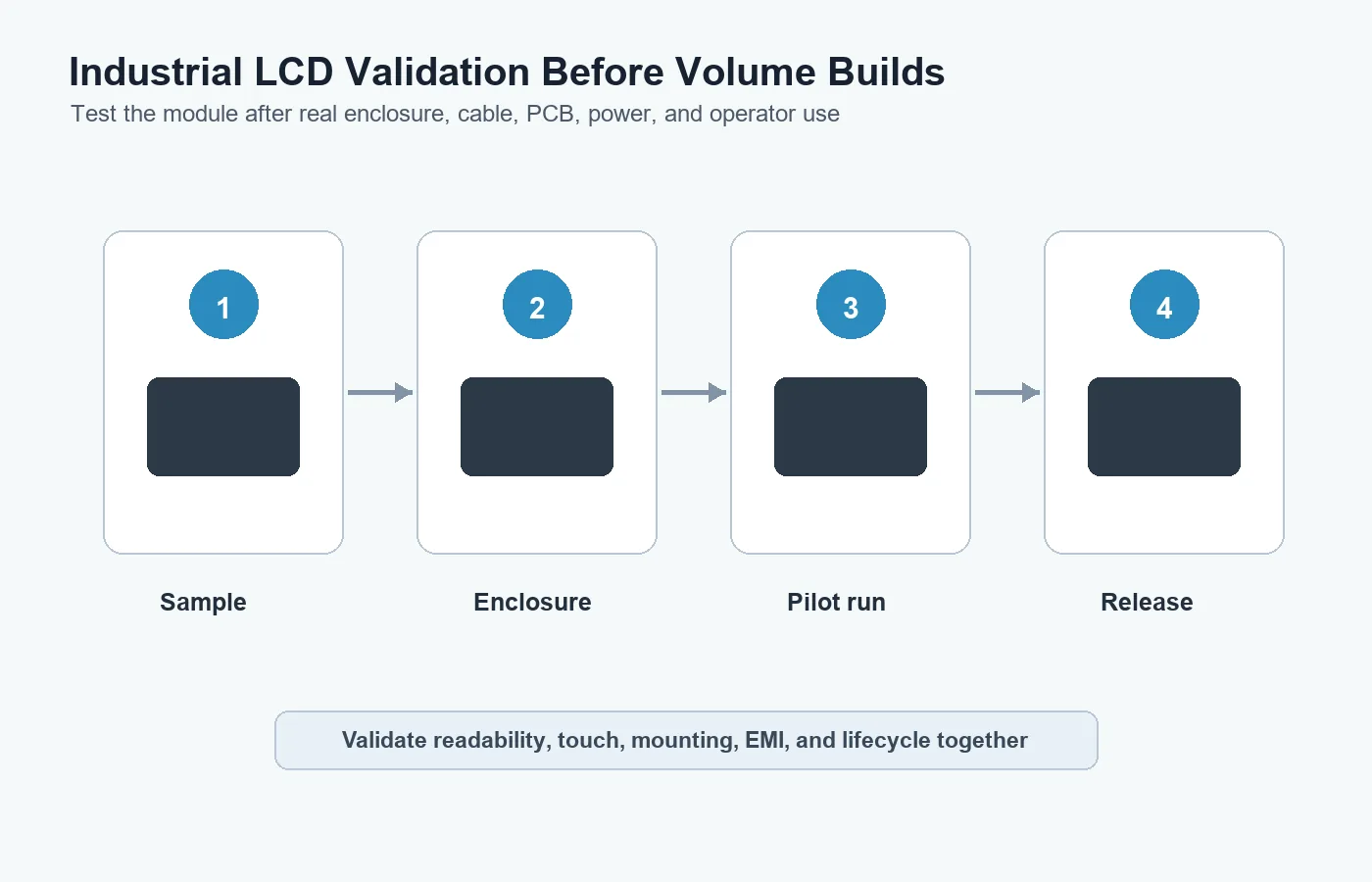 Validate the LCD module after real enclosure, cable, PCB, power, EMI, and operator use are included.
Plan Supply and Change Control
Factory automation products often stay in production for years. A display module change can affect the enclosure, UI layout, cable, firmware, touch tuning, and certification tests. Buyers should confirm lifecycle, alternative options, change notification process, packaging, and forecast requirements before placing volume orders.
A stable supplier should help review drawings, samples, quality criteria, and production risks. When comparing Sunshine Display's LCD display module product range, OEM teams should consider not only the current prototype, but also long-term production and maintenance needs.
Buying Advice for OEM Teams
Before selecting an industrial LCD module, define the machine environment, screen size, viewing distance, touch requirement, brightness target, operating temperature, interface, enclosure structure, and expected product lifecycle. Share this information with the display supplier early so the module can be evaluated as part of the full system.
Sunshine Display supplies LCD display modules for industrial and OEM applications up to 32 inches. If your project involves factory automation, test equipment, control panels, or measurement devices, contact Sunshine Display to review display size, touch structure, mechanical drawings, and production requirements.
FAQ
Are industrial LCD modules different from consumer displays?
Yes. Industrial LCD modules are selected around stability, lifecycle, integration, operating environment, and repeatable production. Consumer displays such as phone or TV panels usually follow different design priorities and supply models.
What matters most for a factory automation LCD?
Readability, touch operation, mechanical fit, temperature range, electrical stability, and long-term supply are usually the most important factors.
Should factory equipment use IPS TFT LCD modules?
IPS is useful when operators view the screen from different angles or when color stability matters. It is not required for every machine, but it is often safer for user-facing control panels.
When should touch performance be tested?
Touch should be tested after the cover lens, enclosure, grounding, cable, PCB, and software interface are included. Bench testing alone is not enough for industrial products.
How can buyers reduce LCD supply risk?
Confirm lifecycle, approved drawings, change notification process, alternative modules, packaging, inspection criteria, and forecast planning before mass production.