E-paper and TFT LCD solve different low-power display problems; the update pattern and user task should decide the choice.
Low-power industrial products are not all alike. A remote water monitor may update a visible status only a few times per day. A pump controller may need live values, alarm transitions, touch input, and continuously changing trends. Both products need an efficient display, but the right technology is not the same.
For OEM teams, the practical question is not simply whether e-paper or LCD uses less power. The question is how the device is used: what users must see, how often the content changes, how quickly it must respond, where it is installed, and what the full product consumes between service visits. E-paper display modules and TFT LCD modules each have strengths that fit different industrial applications.
Start With the Information Update Pattern
E-paper is strongest when information changes occasionally and should remain visible for long periods. The panel retains its last image without continuous display power. This makes it useful for industrial asset labels, maintenance cards, logistics identification, inspection reminders, low-power field devices, and status boards that update only when an event occurs.
TFT LCD is the better fit when the interface changes frequently. It supports fast screen refresh, color graphics, animation, responsive controls, live trends, and detailed menus. Industrial equipment such as pump controllers, process skids, test systems, and factory HMIs often needs that immediate feedback. Standard TFT LCD modules are designed for these active interface roles.
Write down a normal-day update timeline before comparing products. Include scheduled updates, alarms, manual interaction, wireless retries, boot screens, maintenance activities, and exception states. This often makes the technology decision clearer than comparing a single current figure.
Compare Power at the Product Level
An e-paper panel uses energy while it updates, but it does not continuously power a backlight to preserve a static image. That behavior can be valuable for battery-powered and solar-powered devices with slow-changing information. Refresh time may be longer than LCD, and some updates can briefly flash the screen. Partial refresh can improve speed in some designs, but should be validated for image quality and ghosting.
An LCD needs power for its electronics and backlight while it is active. In exchange, it can provide immediate visual response and smooth content changes. The right comparison includes the display controller, processor, sensors, radio or wired communication, power conversion, and sleep behavior. A cellular transmission or high-power sensor may dominate the energy budget regardless of display choice.
Measure a representative prototype. Record sleep current, update or backlight current, wake time, radio events, battery behavior, and temperature effects. A complete duty-cycle measurement is more useful than a module-only specification.
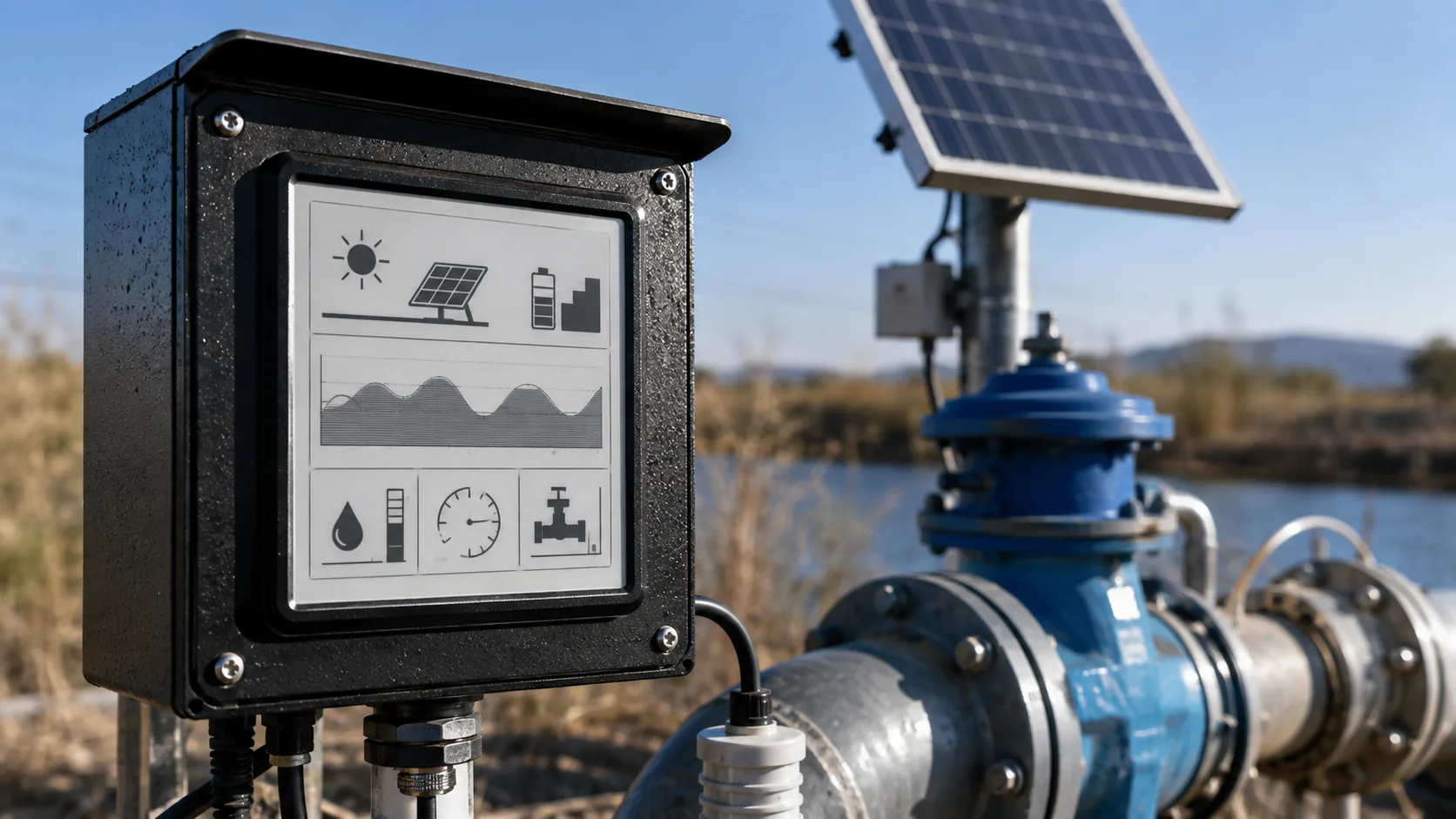 A reflective e-paper module can keep slow-changing status information visible at a battery or solar-powered industrial device.
Choose for the Viewing Environment
E-paper is reflective, so it can remain easy to read in bright ambient light and direct daylight. Its paper-like appearance suits outdoor or high-light locations where persistent monochrome information is needed. The lack of a continuously illuminated backlight can also help preserve a low-power design.
TFT LCD can provide strong visual impact indoors and in controlled lighting, especially for color-coded states, detailed graphics, and live data. Brightness, contrast, cover glass reflection, anti-glare treatment, and mounting angle all affect real readability. If the screen is viewed from several positions, IPS TFT LCD modules can offer more stable viewing behavior.
Neither technology can be selected from a desk alone. Test representative content with the final cover lens and enclosure under the intended lighting. A display that looks excellent in a lab can become difficult to read beside a sunny pipeline or under overhead factory lights.
Consider Color, Response, and Interaction
TFT LCD is normally the more capable option for rich color, real-time graphs, moving graphics, camera views, and fast operator actions. It also supports touch-driven controls when paired with a suitable front panel. Capacitive touch TFT LCD assemblies can be evaluated when the product needs a sealed, responsive industrial HMI.
E-paper works best with deliberate, static content: high contrast, clear hierarchy, large text, simple icons, and limited screen changes. Black-and-white is often the most straightforward choice, while accent or color e-paper may support selected visual priorities. Do not expect e-paper to behave like a video-rate LCD or choose it for a task that relies on instant visual feedback.
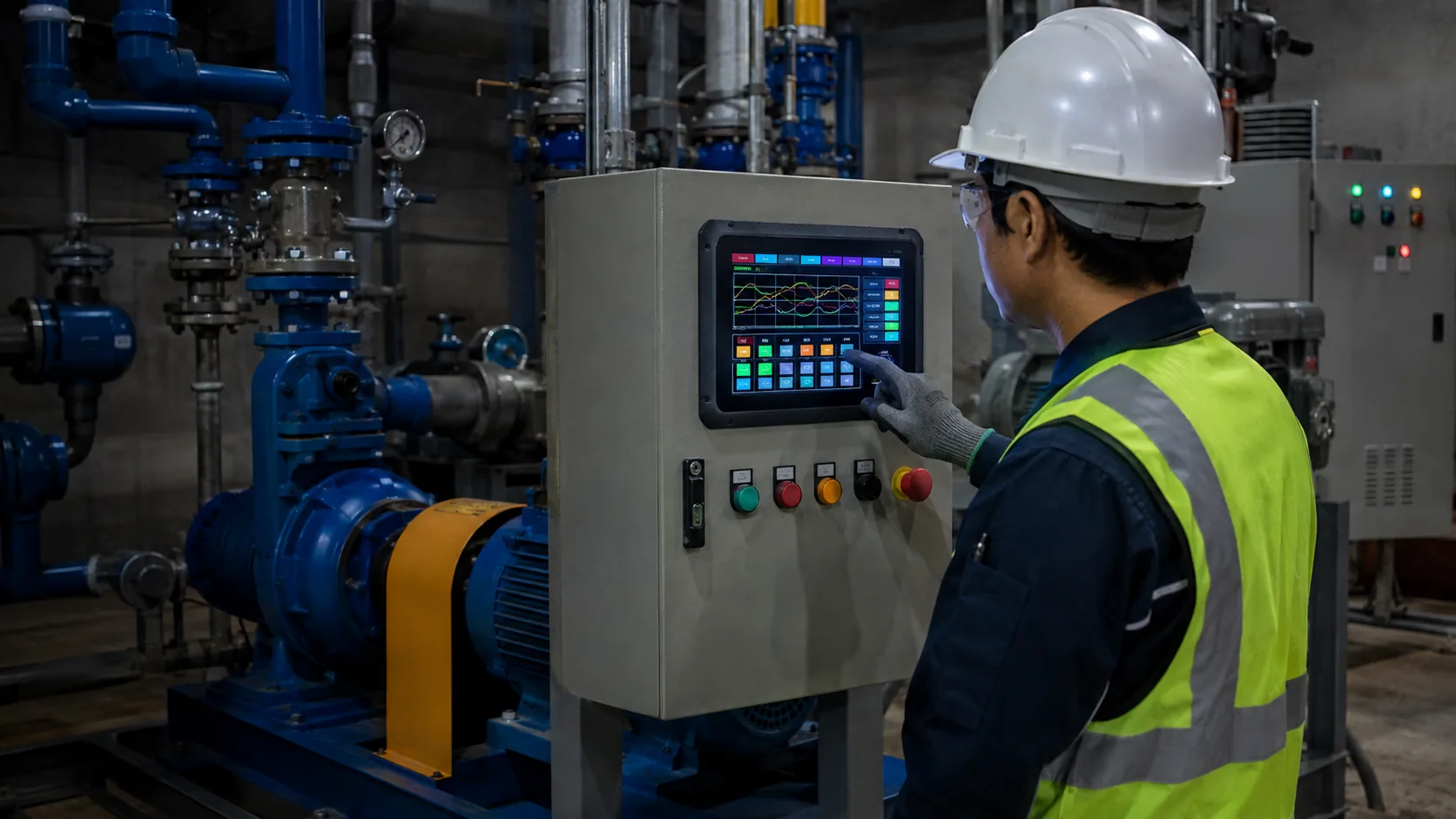 TFT LCD is typically the better fit when an industrial interface needs fast updates, color, animation, touch, and live process data.
Engineer the Complete Industrial Product
The panel is only one part of an industrial device. E-paper products may need a low-power controller, battery, solar input, wireless interface, antenna, enclosure, front lens, mounting system, and update firmware. TFT LCD systems may need a graphics controller, backlight control, touch tuning, cable routing, shielding, and thermal design.
For both technologies, validate the final stack for temperature, moisture, vibration, electrostatic discharge, power interruption, connector retention, and service access. In difficult climates, wide-temperature TFT LCD modules may be relevant for the active LCD portion of a product. The complete solution must meet the environment, not merely the display cell.
Some OEM products benefit from using both technologies. A TFT HMI can handle active machine control, while an e-paper panel presents persistent maintenance, identification, or low-power standby information. This division can improve the experience without forcing either display type beyond its strengths.
A Practical Selection Checklist
Choose e-paper when the visible content is static or changes slowly, sunlight readability is important, and the device needs to preserve energy between updates. Choose TFT LCD when the application needs fast response, live data, color, animation, touch, or frequent user interaction. Then check the actual power budget, required operating temperature, mechanical envelope, lifecycle, integration interface, and supply plan.
For a complete product discussion, share sample screens, update frequency, power source, viewing conditions, housing drawing, controller constraints, expected quantity, and service-life target. Sunshine Display supplies industrial display modules and supports e-paper OEM customization for suitable applications. Contact Sunshine Display to compare e-paper and TFT LCD options for your low-power industrial device.
FAQ
Is e-paper always more energy efficient than LCD?
E-paper has a major advantage for a static image because it does not need continuous panel power to retain it. The complete device energy budget also includes controller, sensors, communication, and refresh events.
Can e-paper replace a TFT HMI?
Not when the product needs fast updates, animation, responsive touch interaction, or continuous live trends. E-paper and TFT can also be combined in one industrial product for different information roles.
What information should an OEM share for a display comparison?
Share the content type, update frequency, viewing environment, power source, response time, touch need, operating temperature, mechanical envelope, interface, lifecycle, and expected annual volume.