Energy storage systems need industrial displays that keep battery status, alarms, and service data readable in equipment rooms and utility sites.
Industrial energy storage systems depend on clear display information during commissioning, daily operation, fault handling, and maintenance. The display is not a decorative part of the cabinet. It is where operators confirm battery status, inverter communication, temperature warnings, protection events, charging and discharging direction, service mode, and system readiness.
For OEM teams selecting a display, the question is not only screen size. The display module must match the enclosure, controller platform, environmental conditions, electrical design, software interface, lifecycle target, and service workflow. Sunshine Display supports industrial display modules for OEM applications, including LCD display modules up to 32 inches and e-paper display modules for low-power or static information needs.
Start With the Operator Workflow
Energy storage equipment can be installed in factories, commercial buildings, utility sites, telecom rooms, renewable energy systems, and outdoor cabinet areas. Each installation creates different display requirements. A commissioning engineer may stand directly in front of the cabinet with a laptop and tools. A maintenance technician may check alarms quickly from the side. A site operator may only need to confirm whether the system is normal, charging, discharging, isolated, or in fault state.
Before choosing a module, define the most important screen tasks. Common examples include battery state of charge, state of health, rack status, voltage and current trends, thermal alarms, isolation warnings, fault history, communication status, and service instructions. If the interface is mainly for active operation, a color TFT LCD module is usually the practical choice. If the information is static and must remain visible during sleep or power-saving mode, an e-paper module can also be useful.
Match Screen Size to Cabinet Design
Energy storage systems may use compact local displays or larger control panels depending on cabinet size and HMI complexity. A small display can show basic status and alarm codes, while a medium-size LCD can support trend charts, multi-rack overview pages, parameter settings, and maintenance menus. For richer interfaces, OEM teams often evaluate standard TFT LCD modules first, then confirm whether brightness, interface, touch, and operating temperature meet the project requirements.
Screen size should be reviewed with the mechanical design. The bezel opening, active area, mounting bosses, gasket, cable route, connector clearance, and cover lens stack all affect final assembly. A display that looks suitable on a datasheet can become difficult to install if the FPC exits in the wrong direction or if the connector interferes with a metal bracket.
Readability Under Real Site Conditions
Battery energy storage cabinets are often installed in environments with mixed lighting. Some are indoors under fluorescent or LED lighting. Others are placed in semi-outdoor shelters where sunlight and reflection can affect readability. The display should be evaluated with real UI screens, not only colorful demo images.
Brightness, contrast, viewing angle, cover glass reflection, and surface treatment should be checked together. If operators view the screen from standing, seated, or side positions, an IPS TFT LCD module may provide more stable color and contrast than a narrow-viewing-angle option. For outdoor or semi-outdoor cabinets, brightness alone is not enough. Cover lens reflection, optical bonding options, anti-glare treatment, and enclosure shading can all change the final result.
When E-Paper Makes Sense
E-paper is not a replacement for every active HMI, but it can solve specific industrial problems. Because e-paper is bistable, it can keep the last image visible without continuous display power. This makes it useful for maintenance labels, service status, cabinet identification, safety notices, inspection dates, QR-code style asset information, and low-power field devices.
For energy storage products, an e-paper display module may be used as a secondary status label while a TFT LCD handles active operation. The e-paper area can remain readable in sunlight and continue showing static information during standby. OEM teams should still review refresh behavior, temperature range, update speed, controller integration, and whether black-white or color e-paper is appropriate for the application.
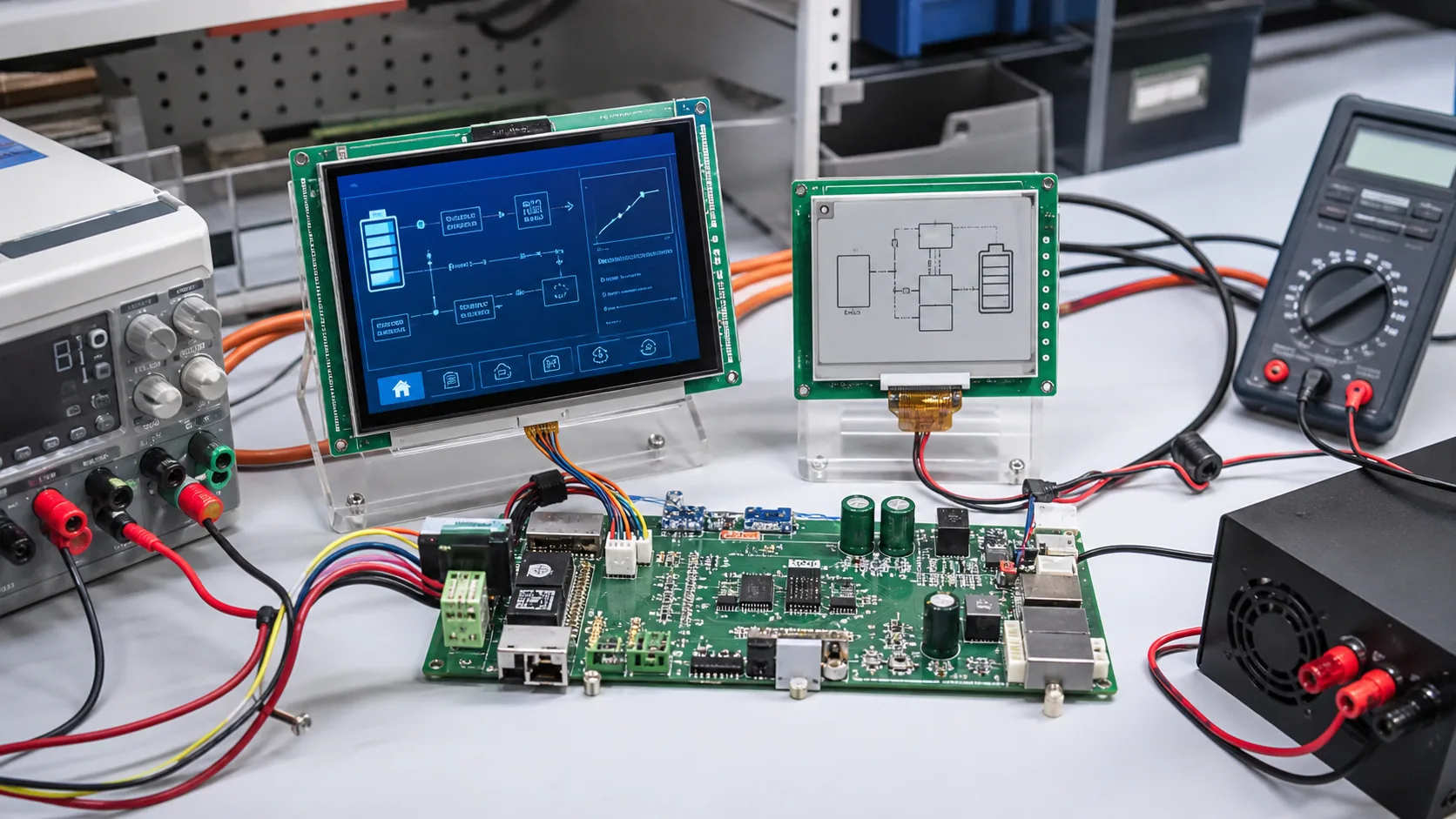 Bench validation should confirm the display interface, power budget, viewing angle, touch response, and controller integration before pilot production.
Interface and Controller Planning
Display interface selection should start from the main controller. Smaller and medium-size modules may use SPI, RGB, LVDS, MIPI, or other interfaces depending on resolution and controller capability. Energy storage HMIs often need stable communication, predictable boot behavior, and low electromagnetic interference risk. The display cable length, grounding, shielding, and connector retention should be considered early.
Software teams should confirm the UI framework, color depth, refresh rate, touch driver, backlight control, and sleep/wake behavior. A display that works on a lab bench may still need tuning for production firmware, startup sequence, and system fault recovery. If the cabinet enters power-saving mode, the backlight control strategy should be coordinated with the BMS or main controller.
Touch, Cover Glass, and Protection
Touch operation can improve service workflow when technicians need parameter pages, alarm history, and guided diagnostics. For many industrial energy storage systems, capacitive touch TFT LCD modules are practical, especially when paired with a suitable cover lens. However, touch design should be tested with gloves, moisture, dust, enclosure grounding, and the final front panel.
The cover glass should protect the display without creating excessive reflection or pressure on the LCD. If the cabinet is exposed to temperature swings, gasket compression, adhesive selection, and tolerance stack must be reviewed. Mechanical stress can cause light leakage, touch instability, or display mura if the assembly is not controlled.
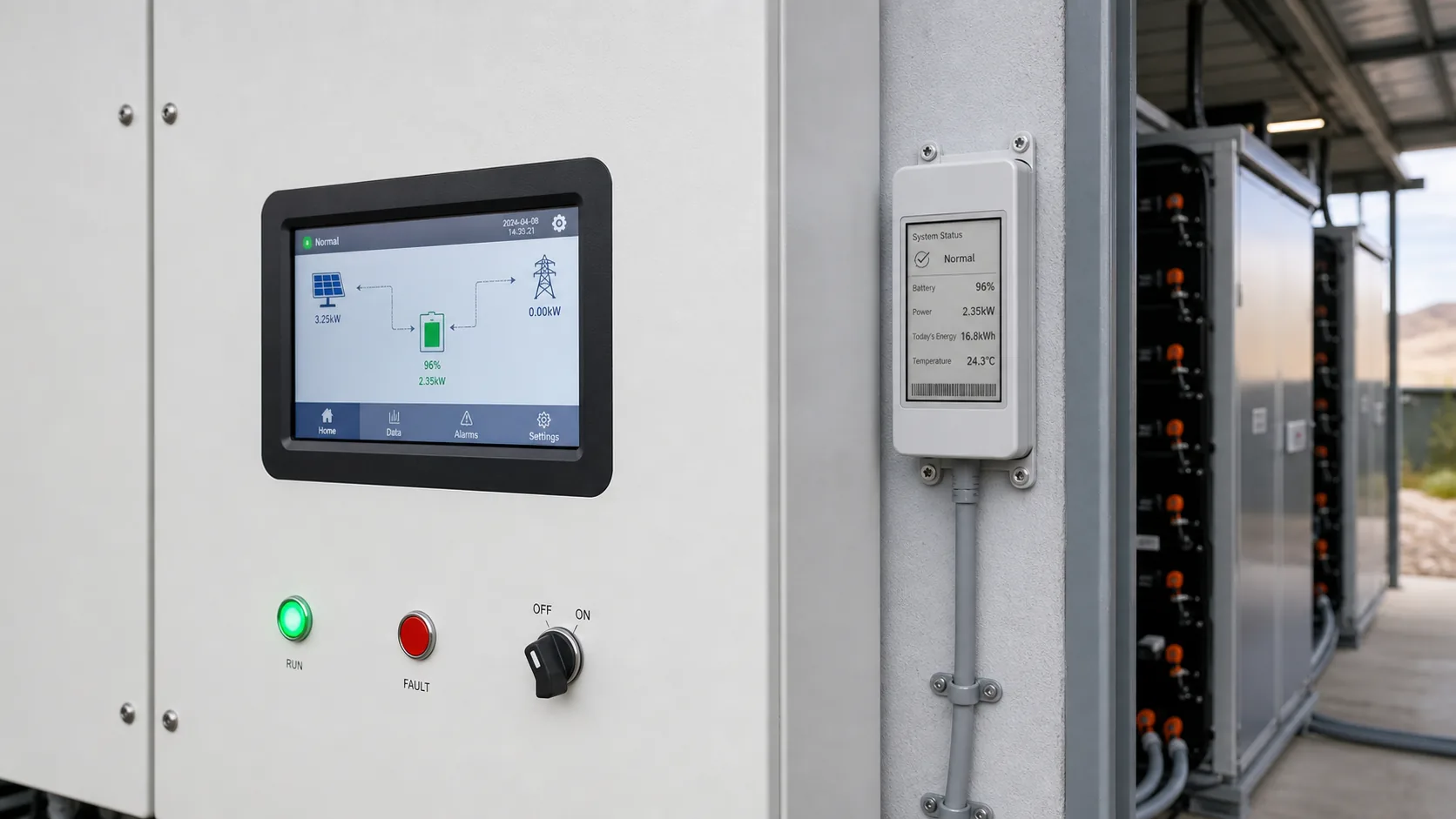 A TFT LCD can support active operation while e-paper can keep static service status visible with very low standby power.
Temperature and Reliability
Energy storage equipment may operate in electrical rooms, outdoor shelters, or sealed cabinets where internal heat can be significant. The display module should match the expected operating and storage temperature range. For demanding environments, OEM teams should review wide-temperature TFT LCD modules and confirm backlight lifetime at the actual brightness setting.
Reliability review should include thermal cycling, vibration during transport, ESD protection, connector retention, backlight aging, touch panel bonding, and cover lens durability. If the product has a long service life, supply stability and change control are as important as the initial sample result.
Practical Buying Advice
When sourcing a display for an energy storage system, prepare a clear requirement list before requesting samples. Include target screen size, resolution, interface, brightness, viewing direction, touch requirement, cover lens structure, operating temperature, expected production volume, enclosure drawing, controller platform, and lifecycle expectations.
Ask the supplier whether the selected module has stable availability, whether compatible alternatives exist, and what customization is realistic for the project timeline. For projects that need a custom cover lens, special FPC, different backlight, e-paper label integration, or complete display subassembly support, discuss the customization scope early. Sunshine Display can help OEM teams review display module options and custom requirements through the contact page.
FAQ
What display type is suitable for an energy storage cabinet?
A color TFT LCD module is usually suitable for active HMI screens, alarms, trend data, and commissioning pages. E-paper can be useful for static equipment status, service labels, or low-power field indicators.
Should an energy storage display use touch control?
Touch is useful when operators need menu navigation, settings, and diagnostics. For harsh sites, OEM teams should also consider glove use, cover glass, sealing, and whether physical buttons are needed for emergency functions.
Why is lifecycle important for industrial display modules?
Energy storage systems often need stable production and service support for many years. Display availability, compatible alternatives, and change control should be reviewed before production release.
If you are developing an energy storage cabinet, battery management HMI, inverter control panel, or low-power service label, contact Sunshine Display to discuss TFT LCD modules, e-paper display modules, and OEM customization options for your industrial display project.