Custom E-Paper Display Modules for OEM Products
E-paper display modules are becoming useful in industrial and OEM products that need clear information with very low power consumption. Unlike a normal TFT LCD that needs continuous backlight power, an e-paper display can keep an image visible after refresh with little or no holding power. This makes it attractive for electronic labels, industrial status signs, warehouse tags, smart instrumentation labels, battery-powered field devices, and custom equipment identification products.
Sunshine Display now supports e-paper display module, and e-paper product OEM customization services, alongside its industrial LCD display modules up to 32 inches. For buyers, engineers, and product managers, the key question is not simply whether e-paper is modern. The real question is whether its refresh behavior, optical performance, size, controller, enclosure design, and update method fit the product.
E-paper display modules are useful for industrial labels and status signs that need low power and clear readability.
Where E-Paper Makes Sense
E-paper is strongest when information changes occasionally but needs to stay visible for a long time. A warehouse location label, asset tag, equipment status card, maintenance instruction plate, instrument nameplate, or low-power outdoor device may not need video or animation. It needs a stable, readable screen that can show text, symbols, barcodes, QR-style codes, or simple status blocks.
For these use cases, the bistable nature of e-paper is valuable. The screen can retain an image without continuous display power, which helps battery-powered or energy-conscious products. E-paper also has a paper-like appearance and is often readable in bright ambient light, making it suitable for labels and signage where users inspect information rather than interact with a dynamic UI.
When reviewing Sunshine Display's broader industrial display module product range, OEM teams should treat e-paper as another display technology option, not a direct replacement for every TFT LCD. It fits a different set of product requirements.
Know the Limits Before Choosing E-Paper
E-paper is not ideal for every application. Refresh speed is slower than TFT LCD, and frequent full-screen updates can create a different user experience. Some e-paper modules may show temporary ghosting, require waveform control, or need temperature-aware driving. If the product needs video, fast menus, rich color animation, or continuous touch UI response, a TFT LCD module may be a better choice.
For industrial HMI screens with frequent interaction, standard TFT LCD modules or IPS TFT LCD modules may be more suitable. For labels, equipment status plates, and low-power products, e-paper can reduce power demand and improve readability under ambient light.
The best selection starts with update frequency, viewing distance, operating temperature, information density, size, interface, and lifetime expectations. A simple label that updates once per day has very different requirements from a wireless device that updates every few minutes.
Review Module, Controller, and Power Design
An e-paper display module is not only the visible panel. The system may include a controller, driver IC, FPC, connector, power circuit, battery, wireless module, MCU, and firmware support. OEM teams should confirm interface type, voltage requirements, refresh waveform support, partial update behavior, standby current, and wake-up timing.
Power design deserves special attention. E-paper can hold the image with very low power, but refreshing the image still consumes energy. Engineers should calculate update frequency, battery capacity, wireless communication current, sleep current, and expected field life. If the product is installed in a remote location, battery replacement or service access should be planned early.
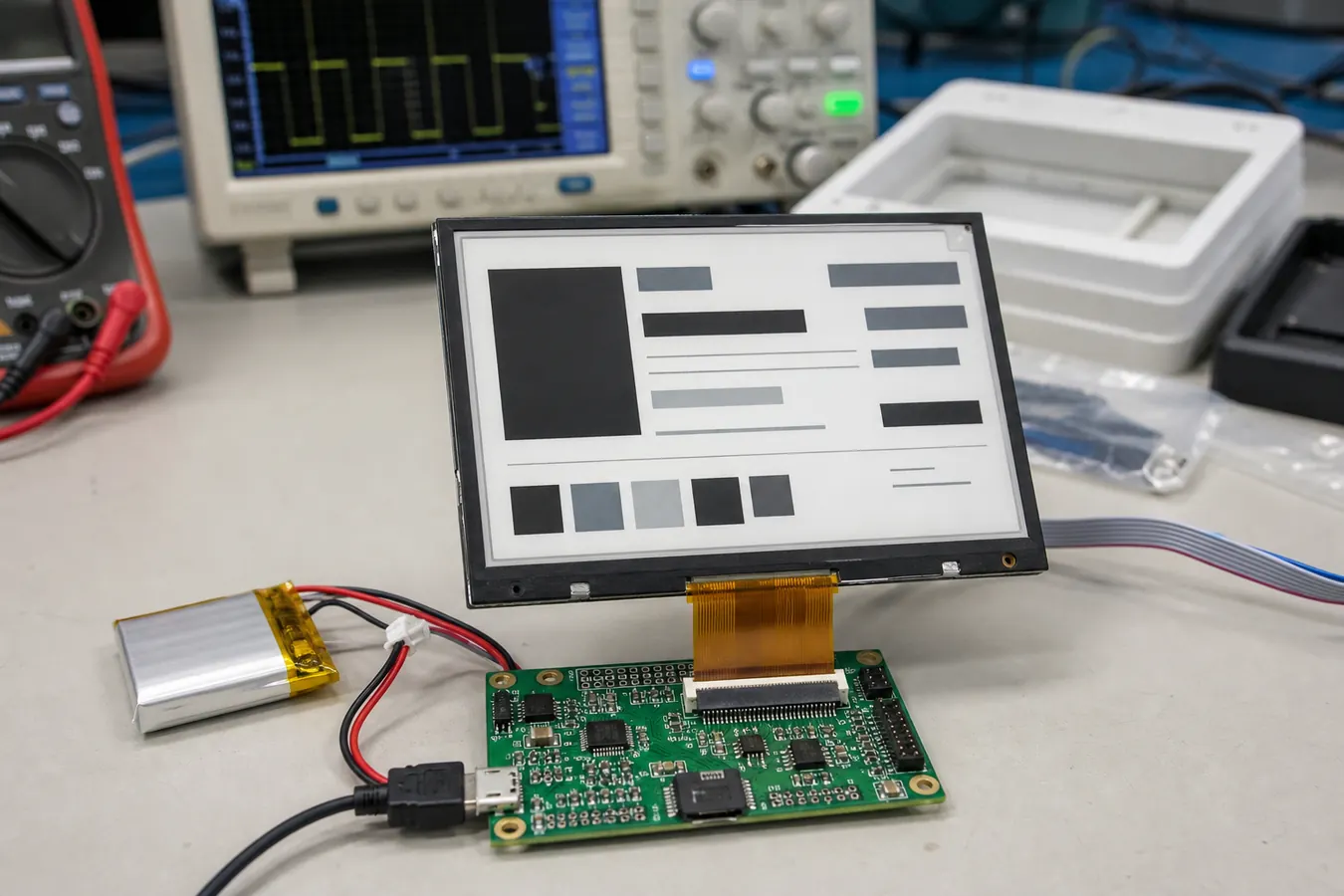 Engineering validation should check refresh behavior, controller integration, power budget, and enclosure fit.
OEM Customization Is More Than Screen Size
Custom e-paper OEM products often need much more than selecting a display panel. The project may involve enclosure size, lens or window structure, gasket design, mounting clips, label holder design, battery placement, PCB shape, antenna clearance, cable routing, sealing level, barcode position, and packaging requirements.
For warehouse and industrial labels, mechanical reliability matters. The device may be attached to bins, racks, tools, equipment cases, or outdoor cabinets. It may face vibration, dust, cleaning, temperature variation, or rough handling. The display should remain readable, the housing should protect the module, and the mounting method should match the real installation.
If the product needs touch or a dynamic color UI, e-paper may not be the best match. In those cases, Sunshine Display's capacitive touch TFT LCD modules may be more relevant. If the product needs static information, low power, and paper-like readability, a custom e-paper design can be a strong fit.
Environmental and Lifecycle Checks
Industrial buyers should confirm the expected operating temperature, storage temperature, humidity exposure, refresh behavior at low temperature, UV or sunlight exposure, and mechanical protection. E-paper readability can be excellent in bright light, but the complete product still needs suitable enclosure and material choices.
Lifecycle planning is also important. Custom e-paper products may require approved drawings, firmware, tooling, PCBs, batteries, labels, assembly procedures, inspection criteria, and packaging. A display change can affect the whole product design, so buyers should discuss change notification, alternative options, sample validation, and forecast planning before volume production.
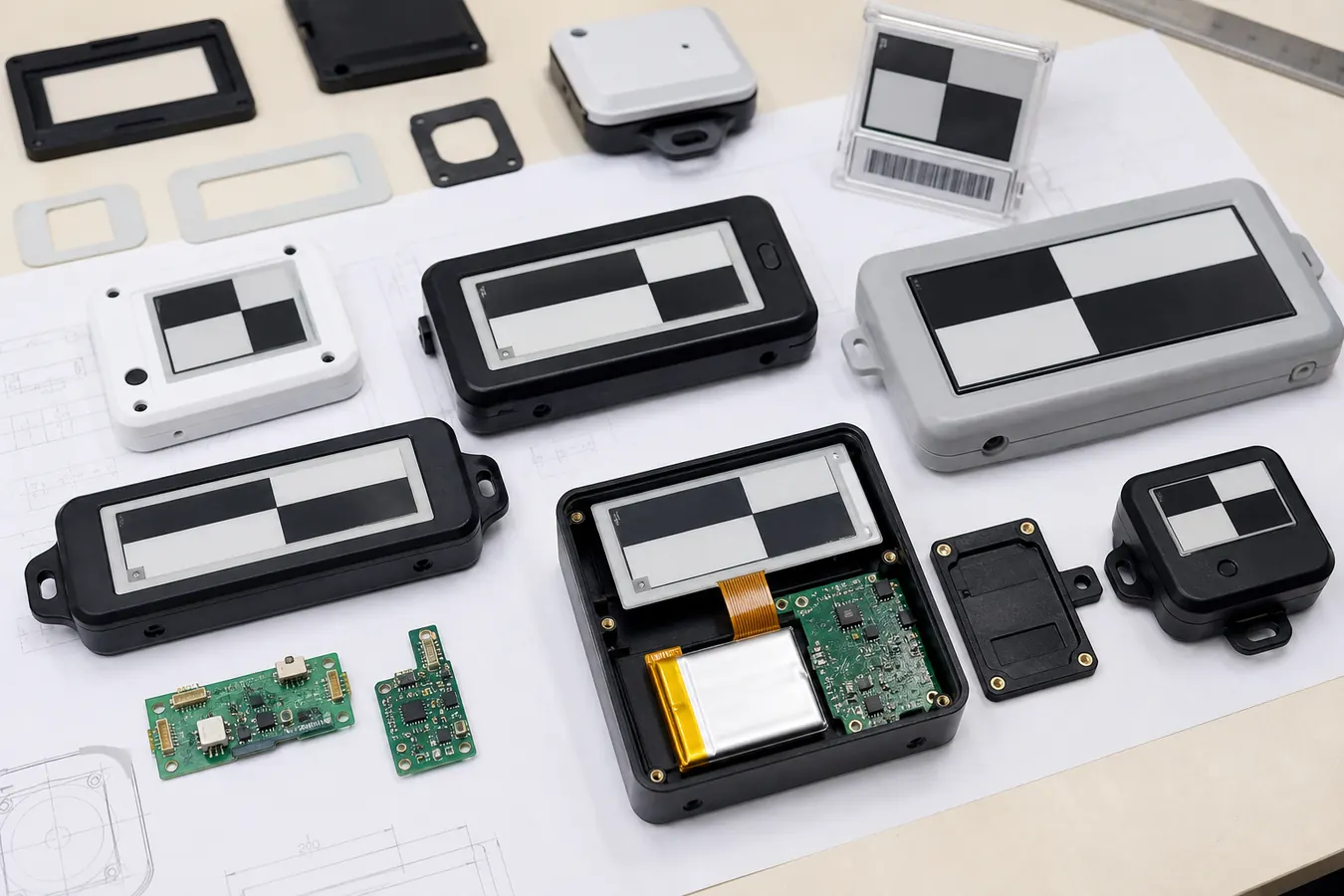 Custom e-paper OEM projects often combine display module, PCB, battery, enclosure, gasket, and mounting design.
Practical Buying Advice
Before starting an e-paper display module or custom e-paper OEM project, prepare the target screen size, display color requirement, update frequency, viewing distance, power source, battery life target, interface, controller preference, enclosure size, mounting method, environmental conditions, wireless or wired update method, and expected annual volume.
Sunshine Display can help OEM teams review whether e-paper, TFT LCD, or another industrial display approach best fits the application. For e-paper module selection or custom e-paper product development, contact Sunshine Display with your target application, size, update method, enclosure concept, and power requirements.
FAQ
What is an e-paper display module best used for?
E-paper is well suited for labels, status signs, asset tags, instrumentation labels, and low-power products where information changes occasionally but must remain visible.
Is e-paper better than TFT LCD?
It depends on the application. E-paper is strong for low power and static readability, while TFT LCD is better for fast refresh, rich color UI, video, and frequent interaction.
Can e-paper displays show information without power?
E-paper can retain an image after refresh with very low or no holding power, but energy is still needed when updating the screen.
What should buyers check for custom e-paper OEM products?
Check display size, update frequency, controller, battery life, enclosure, mounting, sealing, operating temperature, firmware, lifecycle, and packaging.
Can Sunshine Display support custom e-paper products?
Yes. Sunshine Display can support e-paper display module selection and OEM customization for industrial labels, equipment tags, and low-power display products.