Reflective color e-paper can present persistent information in bright ambient light without a continuously operating backlight.
From the mobile phones and tablets we carry to large television screens and digital signage, we live in an era filled with full-color displays. High resolution, saturated color, and multimedia content have become part of everyday life.
As climate change contributes to more frequent extreme weather around the world and countries set net-zero targets, display technology is also being evaluated for its energy use. Applications that do not need a continuously lit, high-refresh screen can benefit from a more energy-conscious display approach. Color e-paper is one of the technologies attracting attention for low-power, reflective display products.
What Is Color E-Paper?
Color e-paper is a color display technology with bistable characteristics. It does not need continuous power to maintain a completed image; power is mainly required when the content is updated. Compared with an LCD that relies on an active backlight during use, this can significantly reduce display energy consumption when information changes only occasionally.
Color e-paper provides a low-power route to full-color display. It uses reflected ambient light to present images rather than relying on an emissive screen. As a result, it can remain readable in direct sunlight and avoids the constant backlight associated with an LCD. For information that should remain visible for long periods, the reflective surface can offer a more paper-like viewing experience.
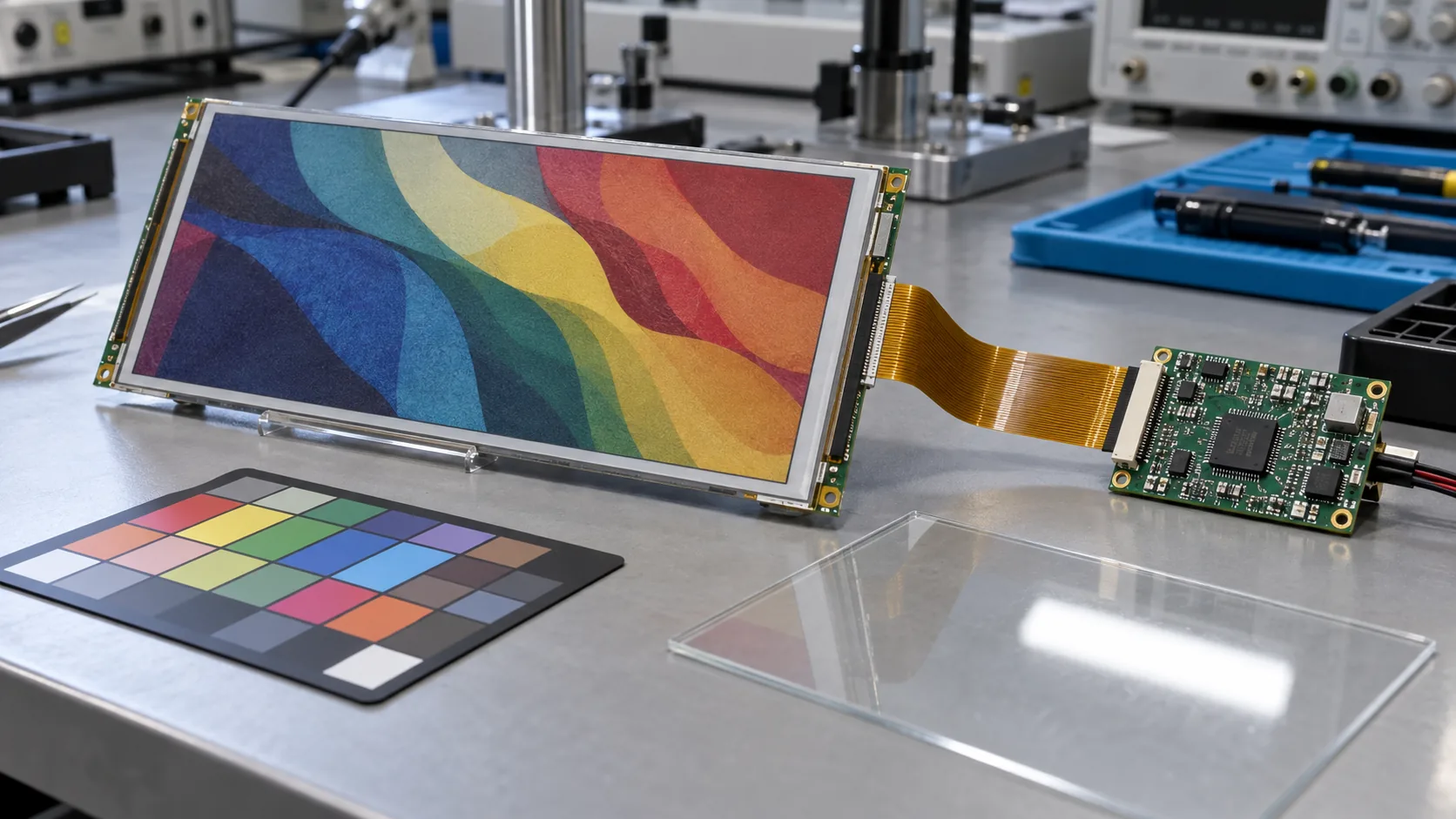 The Basic Principle of Color E-Paper
Several color e-paper technologies are available, including electrophoretic displays and cholesteric liquid crystal displays (ChLCD).
Electrophoretic e-paper uses electrically charged ink particles or capsules to form pixels. It is the mainstream technology in many monochrome e-readers. Color electrophoretic e-paper can use multiple pigment colors or color filters. Its achievable color performance varies by panel technology, and it may not match the broad color gamut associated with conventional RGB LCD screens.
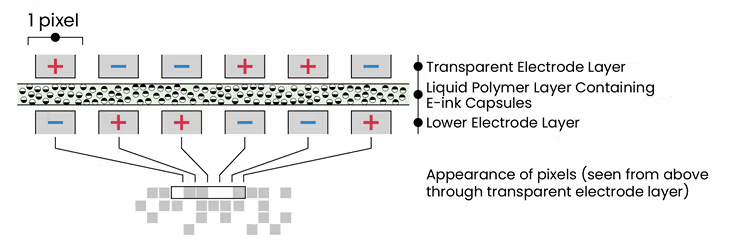
Electrophoretic e-paper uses charged ink capsules to form pixels.
Cholesteric liquid crystal technology can use stacked liquid-crystal layers that respectively reflect red, green, and blue wavelengths. Its bistable behavior allows two naturally stable states:
- In the planar state, liquid-crystal molecules are arranged so that a particular wavelength is reflected. This is the state in which a reflected color is visible.
- In the focal conic state, molecular arrangement allows light to pass through the layer, revealing the color or structure beneath it.
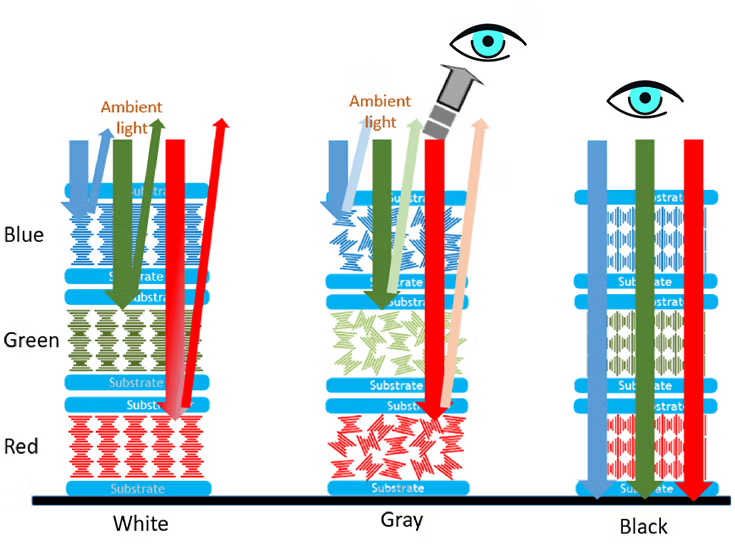
By adjusting the molecular alignment of different ChLCD layers, the display achieves full reflection (white), partial reflection (gray), and transmission (black).
By independently adjusting the states of red, green, and blue layers, a color cholesteric liquid-crystal display can create white, gray, black, and a wide range of reflected colors. This makes it an important approach for applications seeking an alternative to emissive LCD or LED display technologies.
Benefits of Color E-Paper
Low energy use and environmental potential
Color e-paper consumes most of its energy during an update. Where an image changes at intervals such as every few minutes, every shift, or when an event occurs, its display power demand can be far lower than that of a continuously illuminated LCD. This can help reduce the energy footprint of information displays, labels, signs, and low-power industrial products.
Comfortable reflective viewing
E-paper presents an image by reflecting environmental light. It does not use the same always-on backlight approach as a typical LCD. In suitable lighting conditions, this reflective mode can provide a comfortable reading experience for information that remains on screen for long periods.
Sunlight readability
In direct sunlight, a reflective e-paper display can retain good visibility because it uses the available light. An LCD often needs higher brightness to compete with outdoor light, increasing power demand. This makes color e-paper relevant for outdoor signs, transport information, and industrial displays exposed to bright conditions.
Potential solar integration
Some cholesteric liquid-crystal display designs can be considered alongside photovoltaic layers or solar-assisted product architectures. The practical result depends on the optical stack, power requirements, enclosure, local light conditions, and the complete energy system. It is an area worth assessing for outdoor products designed around ultra-low-power operation.
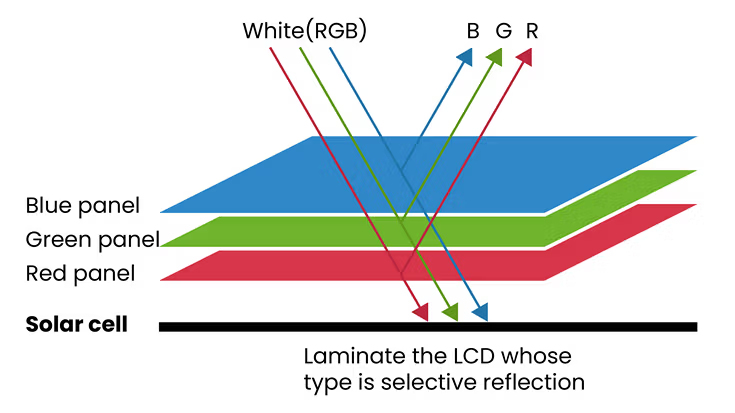
By replacing the lower cholesteric liquid-crystal layer with a solar panel, e-paper can generate electricity from ambient light.
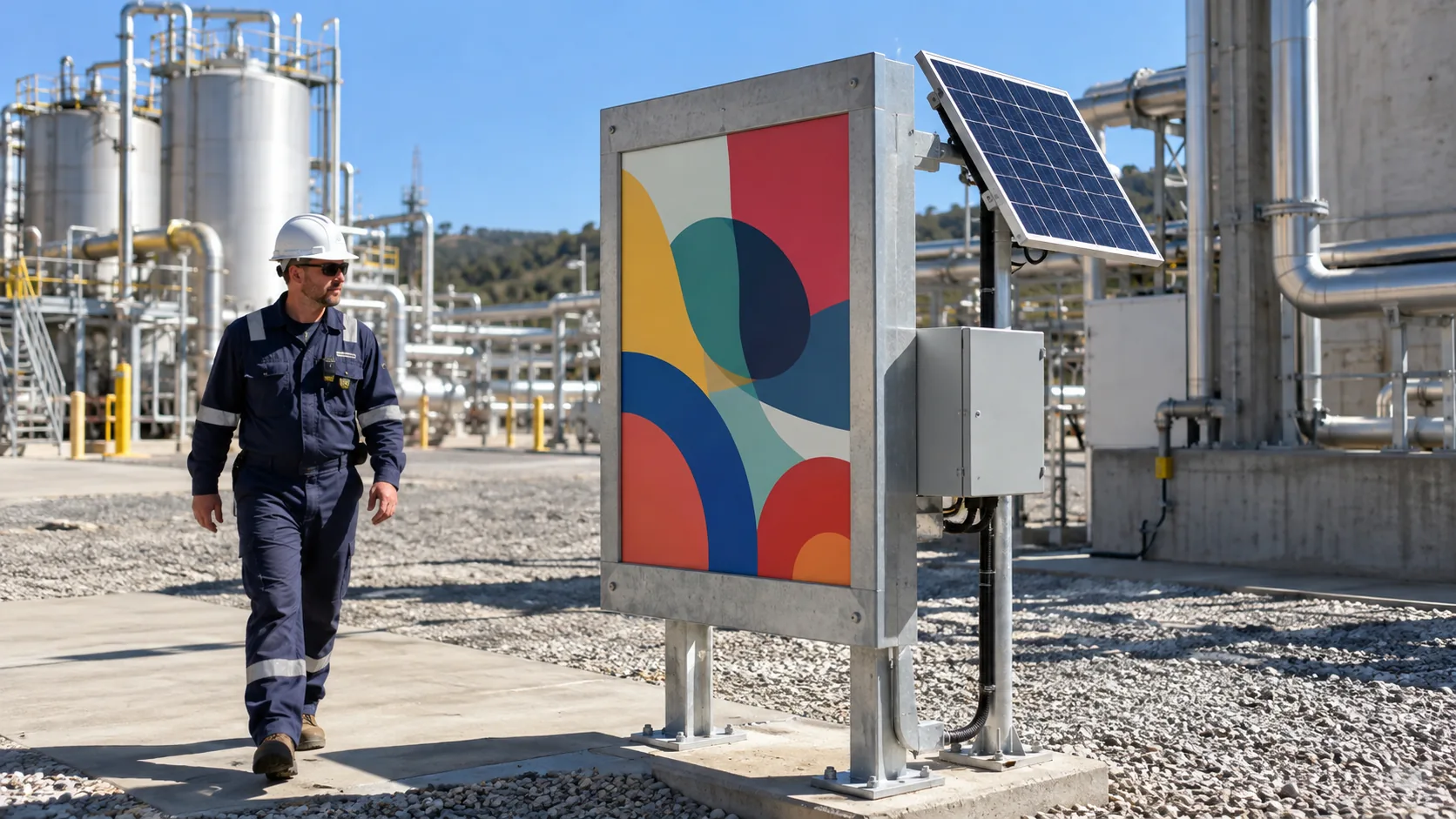 A low-power display architecture can be considered for outdoor products where ambient-light readability and energy planning are central requirements.
Applications for Color E-Paper
Color e-paper can support energy-conscious information display applications when its update behavior matches the task:
- Public transportation and outdoor information: Reflective displays can present schedules, wayfinding, service notices, and changing information with high daylight readability and low display holding power.
- Education and reading: A reflective color display can support educational content and e-reading scenarios where comfortable viewing and reduced paper use are important.
- Retail and public communication: Low-power color displays can be considered for menus, posters, product information, and installations where an image remains in place for extended periods.
- Healthcare and industrial operations: Persistent local information can support digital workflows, provided the product design defines the correct information source, update controls, privacy requirements, and validation responsibilities.
Color e-paper is not intended to replace every LCD. Fast animations, video, and rapidly changing live data still call for active display technologies. For product teams considering e-paper display modules, the key questions are how often the image changes, how the product is viewed, how color is used, and how the display integrates with the enclosure, controller, and power system.
Sunshine Display supports industrial display modules including e-paper display module and OEM customization discussions. For a product using an active color interface as well as a persistent low-power screen, our standard TFT LCD modules may also be relevant. Contact Sunshine Display to discuss your target size, color requirement, update pattern, and industrial application.