1. Strategic Context: Bridging Consumer Expectations and Automotive Rigor
The modern automotive cockpit has become the primary battleground for brand differentiation. Drivers now demand a seamless transition from their mobile devices to the vehicle, expecting high-fidelity infotainment, smartphone-level responsiveness, and ubiquitous connectivity. However, as systems architects, we recognize the inherent paradox: delivering this "consumer-grade" experience while maintaining the uncompromising safety and durability required of automotive-grade hardware. This tension is further complicated by the lifecycle requirements of the automotive industry, where components must remain viable and available for a decade or more.

Sunshine Display (Sunshine) provides the technical maturity and supply chain stability required to navigate these challenges. By synthesizing decades of display expertise with a proven track record as a Tier 1 supplier, Sunshine mitigates the primary risks of automotive R&D: Bill of Materials (BOM) instability and technical obsolescence. Our engineering teams do not merely provide components; they provide architectural reliability that ensures long-term availability and consistent performance throughout the vehicle's production life. This technical diversity is the foundation of a modern, multi-functional cockpit.
2. Defining "Automotive-Grade": A Comparison of Standards
Achieving an automotive-grade rating requires adherence to stringent specifications that far exceed consumer electronic standards. The table below outlines the primary dimensions where these requirements diverge:

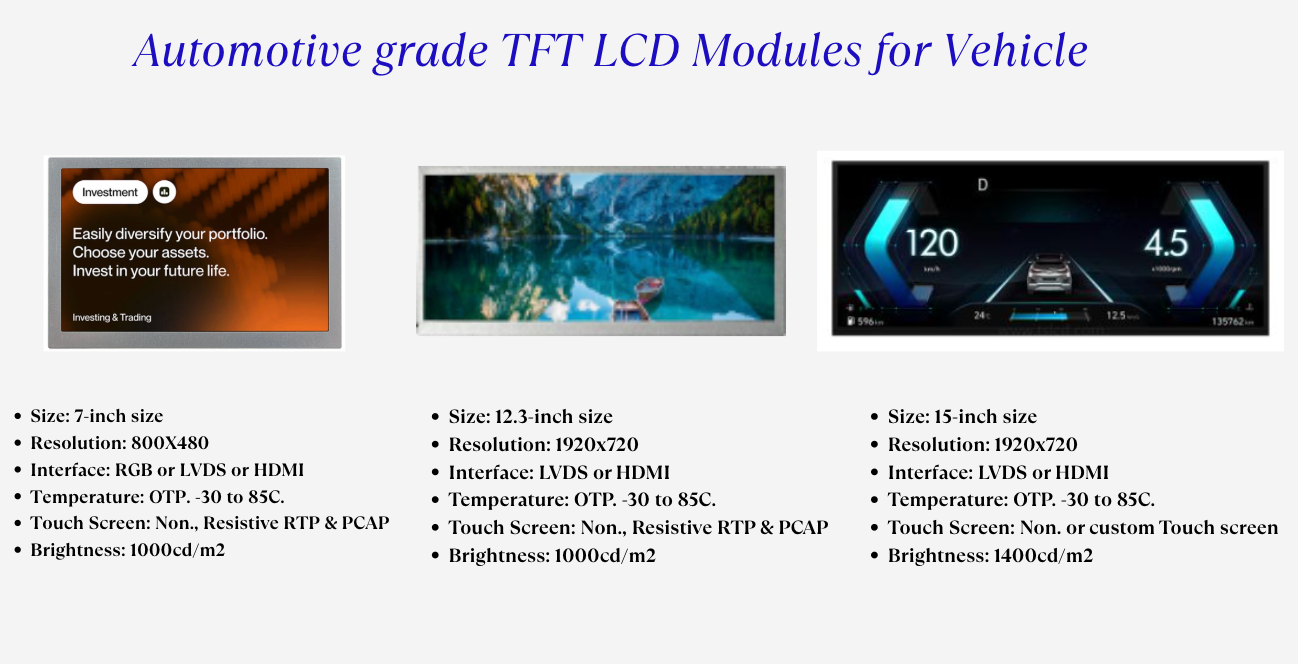
To meet these benchmarks, engineers utilize a specific portfolio of hardware technologies, particularly for displays under 15.6 inches (diagonal):
2.2 Diversified Display Technologies for Specialized Cockpit Roles
A "one-size-fits-all" approach to displays is fundamentally incompatible with modern vehicle architectures. From high-resolution instrument clusters to low-power status indicators, each touchpoint requires a technology stack optimized for its specific functional and environmental role. Sunshine maintains a comprehensive portfolio of display technologies, each serving a distinct architectural purpose:
- High-Performance TFT Displays (<15.6”): Optimized for high-resolution infotainment and digital clusters where color depth and refresh rates are critical for complex graphical user interfaces (GUIs).
- TN & ASTN Displays: These technologies remain the standard for high-contrast, cost-efficient interface modules, such as HVAC controls, where reliability in extreme temperatures is paramount.
- Capacitive Switches for TFTs: A critical integration point that allows for the blending of tactile physical controls with digital display flexibility, enhancing the tactile feedback of the cockpit.
3. High-Performance Interaction: In-House Touch Controller Tuning
In the electromagnetic environment of a vehicle cabin, "noise" is the enemy of interaction. Traditional touch solutions often suffer from high latency or phantom inputs caused by vehicle electronics. Sunshine addresses this by performing all touch controller tuning internally, rather than treating the controller as a "black box" outsourced to third-party vendors.
From an architectural standpoint, internal tuning allows for the optimization of the Signal-to-Noise Ratio (SNR) and a significant reduction in touch latency. By tuning the controller to the specific electrical profile of the vehicle’s enclosure and the underlying OS/middleware, Sunshine delivers application-specific performance that third-party solutions cannot match. Our PCAP and RTP solutions are engineered for high-stakes versatility:
- Environmental Resilience: Robust water and salt-water rejection ensures consistent performance in all conditions.
- User Versatility: High-sensitivity sensing supports multi-finger touch, heavy glove operation, and stylus input.
- Advanced Sensing: Support for proximity detection and air gestures enables contactless "spatial" interaction, reducing driver distraction.
This level of interaction performance is irrelevant if the display is obscured by glare or environmental buildup, necessitating advanced optical engineering.
4. Optical Engineering and Surface Customization
Optical treatments are critical for driver visual ergonomics. A display that is unreadable in direct sunlight or marred by fingerprints is a safety hazard and a failure of perceived quality. Sunshine’s optical engineering suite is designed to maximize legibility and maintain the cockpit's premium aesthetic:
- Anti-Glare (AG): Diffuses ambient light to eliminate the "mirror effect," crucial for safety-critical displays like instrument clusters.
- Anti-Reflective (AR): Uses vacuum-deposited thin-film coatings to minimize light loss and maximize contrast ratios.
- Anti-Fingerprint (AF): Reduces the visibility of oils and ensures the screen remains clear even under heavy interactive use.

For Tier 1 integrators, Sunshine provides integrated touch, display, and cover lens assemblies. These fully bonded modules streamline the supply chain and ensure that the entire optical stack is environmentally sealed and optimized for durability before reaching the vehicle assembly line.
5. Solving Engineering Challenges: Safety, EMI, and Durability
The bridge between a design concept and a production-ready component is built on solving rigorous engineering hurdles regarding safety and electromagnetic compatibility (EMC).
- Collaborative Head-Impact Engineering: Sunshine designs assemblies to be compliant with head-impact requirements. Because compliance is contingent on the customer’s enclosure and structural design, we engage as a collaborative engineering partner early in the design phase to ensure the mechanical integration of the display assembly supports occupant safety.
- EMI and Noise Immunity: Utilizing automotive-grade controllers with specialized noise immunity features, Sunshine ensures that the touch system remains stable and accurate despite the proximity of high-frequency vehicle electronics.
- Reliability & Lifecycle Management: Every component is designed for the standard automotive temperature range. Crucially, Sunshine focuses on long-term availability, mitigating the risk of component EOL (End of Life) halfway through a vehicle's production cycle—a common failure point in consumer-grade supply chains.
Our expertise in these areas is validated by our work in other harsh environments, including aeronautic controls and heavy-duty agricultural/construction vehicles, where vibration and environmental extremes are the norm.
6. Manufacturing Excellence and Global Quality Assurance
In the automotive supply chain, consistency is the ultimate measure of quality. Sunshine has maintained IATF16949 certification since 2009, demonstrating a long-standing commitment to the zero-defect manufacturing culture required by global OEMs.
To ensure supply chain resilience, Sunshine has strategically expanded its manufacturing footprint. While our headquarters remain in Zhaoqing guangdong, our manufacturing expansion in Vietnam (now celebrating its second year) serves as a critical geopolitical risk mitigation strategy. This "China + 1" approach provides our partners with the manufacturing scale of a global leader while ensuring the supply chain resilience required to support global vehicle platforms against regional disruptions.
7. Conclusion: Advancing the Cockpit Experience Through Partnership
The evolution of the automotive cockpit from a series of discrete gauges to an integrated digital experience requires a partner that understands the journey from "proof of concept" to "feasible design.
By combining a diverse technology portfolio—including TFT, ASTN Displays, and PCAP—with rare internal expertise in touch controller tuning and optical engineering, Sunshine solves the complex engineering paradoxes of the modern vehicle. We are committed to delivering industrial-strength, durable, and highly functional display solutions that set the standard for the future of mobility.