In the hardware sector, we frequently discuss the persistent engineering bottleneck between panel response times and color accuracy. For most users, selecting a display involves a compromising trade-off: do you prioritize the vibrant, wide-gamut reproduction of modern panels, or the raw, instantaneous performance required for competitive play? While newer technologies like IPS and VA have claimed the mainstream market, Twisted Nematic (TN) panels—one of the earliest liquid crystal display (LCD) architectures—remain a dominant force in high-stakes environments.
Far from being an obsolete relic, TN technology has undergone a specialized evolution. It has transitioned from a general-purpose display standard into a precision tool for specific industries where latency is the only metric that matters. This post explores why TN remains a "core competitiveness" in the professional gaming and industrial sectors, standing its ground against technically "superior" rivals.
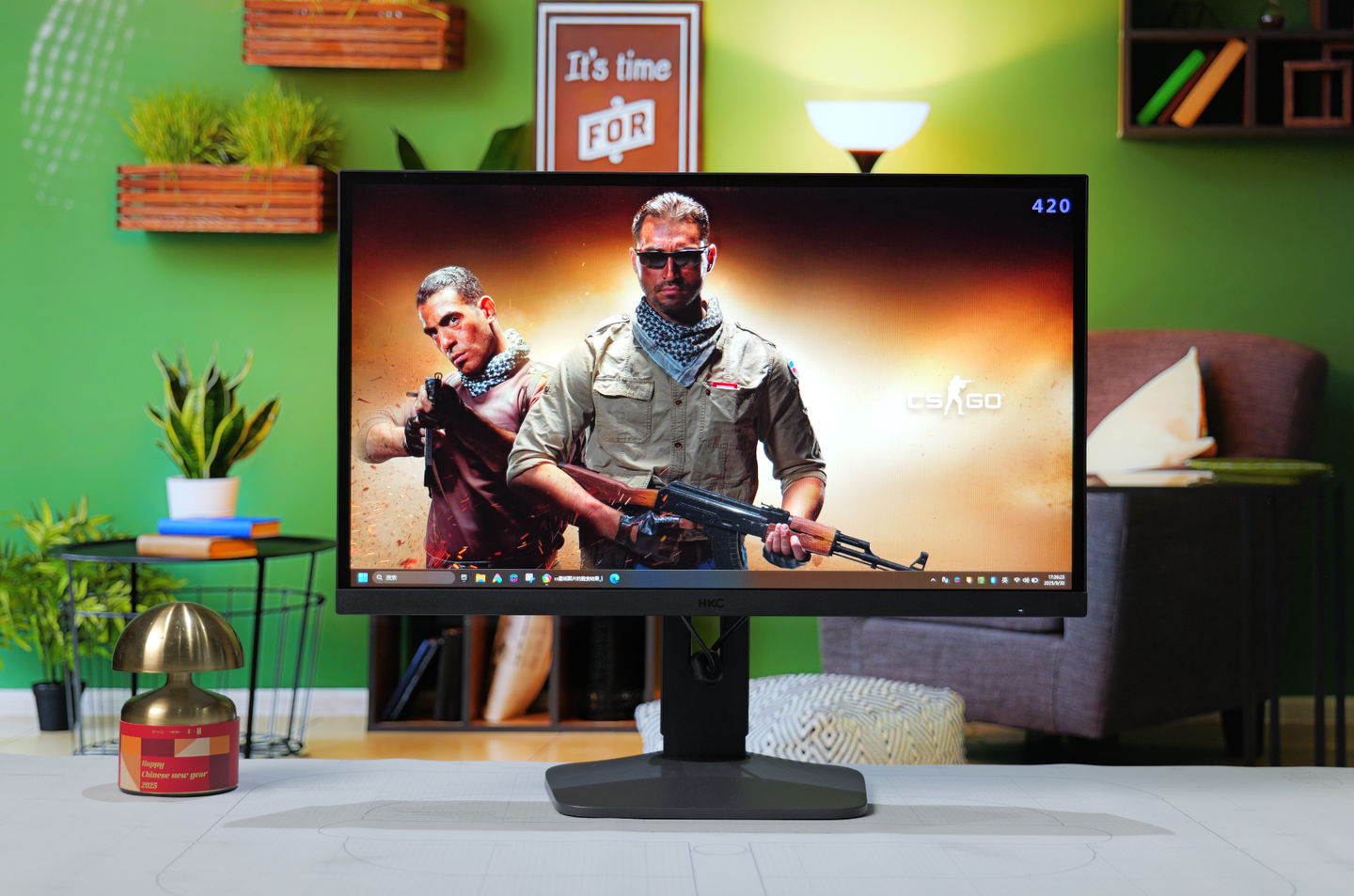
The 1ms Speed Barrier: The Ultimate Game Changer
In the world of high-tier esports, visual fidelity is secondary to the elimination of motion blur. TN panels are engineered for rapid liquid crystal transitions, achieving a level of responsiveness that remains the gold standard for high-speed motion. While other technologies have made strides, TN still holds the edge in maintaining sharpness during the chaotic, high-velocity movements of professional play.
This responsiveness is critical for minimizing "ghosting"—the faint, distracting trail left behind by moving objects that can obscure a player's target. By maintaining a 1ms threshold, TN ensures the image remains as crisp as the player's reflexes.
"Typically 1ms or less, suitable for high-speed motion graphics... to reduce ghosting."
The "Eye-Level" Rule and Vertical Gamma Shift
The primary trade-off for TN's speed is a restrictive viewing angle, typically cited at approximately 170°. However, for a professional analyst, the raw degree number is less important than the nature of the shift. TN panels are uniquely susceptible to "gamma shift" and "image inversion," particularly on the vertical axis. If viewed from below, the image can appear to invert its colors entirely, a phenomenon rarely seen in IPS or VA counterparts.
The Necessity of Physical Positioning
Because of this quirk, TN screens require a disciplined physical setup. To avoid "color casts"—where the top of the screen looks darker or more washed out than the bottom—the user must adhere to the "Eye-Level Rule." Keeping the center of the display perfectly level with the eyes isn't just a comfort recommendation; it is a functional necessity to maintain visual consistency across the panel.
A Masterclass in Specialized Evolution: The Esports Niche
There is a fascinating market irony at play: as TN technology "gradually retreating" from the creative and cinematic markets, it is doubling down on its dominance in the esports segment. TN isn't surviving by trying to match the color depth of IPS; it is surviving by diverging into a hyper-niche of high refresh rates (often referred to in manufacturing contexts as "high brushing" or scan rates) and ultra-low latency.
While the following data—provided by industrial sources—shows TN leading in speed, it also highlights the inherent bit-depth limitations that necessitate specialized hardware for pro-grade use.
Technology Comparison: TN vs. IPS vs. VA
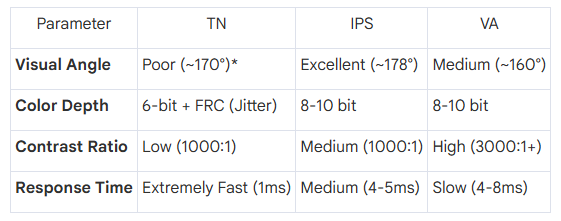
*Note: While TN may cite a wider raw degree spec than some VA panels in specific manufacturer tests, TN is significantly more prone to vertical color inversion.
Efficiency and Stability in the Industrial Shadows
Beyond the neon lights of the gaming arena, TN panels are the backbone of the "Intelligent Industrial Control" and "Mobile Finance Device" sectors. In these environments, color accuracy is irrelevant; what matters is high stability and long-term operational reliability.
TN panels benefit from a simpler liquid crystal orientation, which translates to lower power consumption. This makes them the pragmatic choice for industrial laptops and portable financial terminals where maximizing battery life and ensuring the screen can run for thousands of hours without failure outweighs the need for a wide color gamut.
The High-End TN Hybrid
While TN is synonymous with cost-efficiency, there is a specialized tier of "high-end" TN screens. These units use advanced coating technology to bridge the color gap, attempting to provide a more competitive gamut without sacrificing the panel’s native speed. However, these are niche products with a very specific market position.
"A few high-end TN screens improve color through coating technology, but the price is close to IPS."
For most, the high price of these coated hybrids negates the "low cost" advantage of TN, making them a choice only for the most uncompromising performance purists who refuse to move to IPS.
Conclusion: The Future of Functional Performance
In the tech industry, a technology is never truly "obsolete" if it continues to perform a specific task better than any successor. While professional designers and film editors require the 10-bit color of an IPS or VA panel, the pro-gaming world operates on a different set of physics.
TN is no longer just a budget choice; it is a performance choice. It represents a commitment to the "instantaneous" feel of a game that even the most expensive modern panels can struggle to replicate. The decision for the consumer is simple but profound: would you sacrifice the depth of a billion colors for a single millisecond of competitive advantage?
Click here to view standard TFT module products.
Click here to view IPS TFT module products.
Click here to view sunReadable TFT module products.
Click here to view TFT with Capactive Touch Screen products.