Introduction: The "Consumer-Gap" Paradox
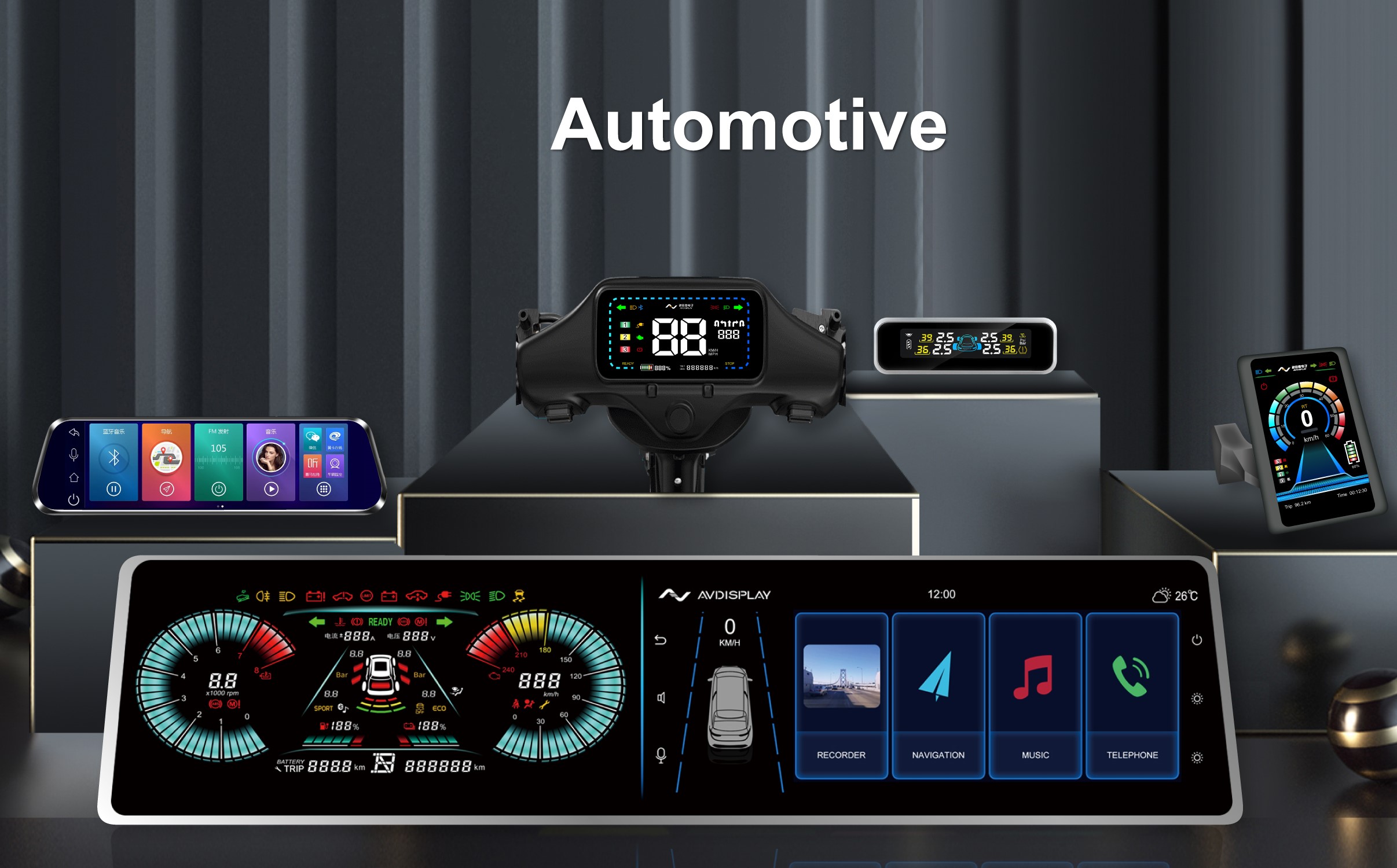
For over a decade, a jarring disconnect has existed between our pockets and our parking spots. While consumers have grown accustomed to the ink-black levels and retinal-sharp resolutions of their smartphones and OLED televisions, automotive displays have historically felt like "last-gen" relics. This "Consumer-Gap" paradox—where a $60,000 vehicle features an interface inferior to a $600 handset—was born of necessity. Automotive screens must endure environmental torture that would destroy a consumer tablet in hours, from icy -35°C winters to 85°C cabin soak in the summer sun.
As a UX strategist, I see this gap finally closing. We are witnessing a convergence of high-level AI, advanced material science, and display engineering that is transforming the dashboard from a static information panel into a "living" digital fabric. The brilliance we expect at home is finally being ruggedized for the road.
1. Local Dimming: Closing the "OLED Gap" Without the Burnout
Historically, automotive Liquid Crystal Displays (LCDs) suffered from "light leakage." Traditional edge-lit panels use a global backlight that stays on regardless of the image, turning deep blacks into a muddy gray hue—a phenomenon that is particularly distracting during nighttime driving. While OLEDs offer a perfect 1,000,000:1 contrast ratio, they often struggle with the peak-illuminance required to overcome direct sunlight and face significant "burn-in" and lifetime hurdles in high-heat environments.
The solution is Full-Array Local Dimming. By placing LEDs directly behind the LCD panel and dividing them into individually controlled zones, we can dim the light exactly where the image is dark. However, from a Futurist’s perspective, success is contingent on zone density; too few zones can lead to a "halo effect" where light bleeds around bright objects.
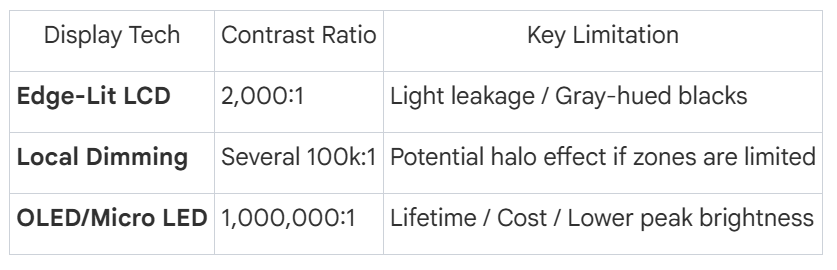
By bridging this gap, local dimming allows for displays that rival OLED's depth while delivering the 1,500-nit punch needed for high-noon visibility.
2. The Windshield as an AI-Powered Canvas
The Head-Up Display (HUD) is migrating from its military aviation roots into a sophisticated Human-Machine Interface (HMI). We are moving beyond simple digital speedometers toward Sensor Fusion, a process where AI synthesizes data from camera feeds, radar, and LiDAR to create a digital twin of the world on your windshield.
Companies like WayRay are leading this charge with their True AR HUD, which uses holographic overlays to project navigation cues that appear to sit directly on the asphalt. Strategic partners like General Motors, Ford, Continental, and Panasonic Automotive are increasingly using this technology to reduce "cognitive load." When the glass itself identifies a pedestrian or a pothole via AI-enhanced object recognition, the driver no longer needs to look away from the road to interpret a 2D map. The interface becomes a proactive safety guardian rather than a passive screen.
3. Morphing Controls and "Virtual Sky" Canopies
The cockpit of 2025 is breaking the conventional framework of automotive architecture. Working with its subsidiary BHTC, the innovator AUO is reimagining the interior as an immersive theater.
Three specific innovations define this shift in UX strategy:
- Morphing Center Control: To balance digital flexibility with physical safety, this interface sits flush as a flat panel when idle. When activated, the surface rises into 3D physical buttons with tactile feedback, allowing drivers to adjust gears or climate control without visual distraction.
- Foldable Cruise Pilot: This represents the ultimate transition between manual and autonomous modes. In manual mode, the steering wheel and display are semi-folded, showing only speed and mileage. In autonomous mode, they fully unfold into a panoramic media suite for video conferencing or shopping, turning the car into a mobile workspace.
- Virtual Sky Canopy: This transforms the sunroof into a transparent Micro LED display. It can shift from a clear view of the stars to an interactive "360-degree theater" with adjustable transparency to manage sun exposure and privacy.
4. Built for Battle: The Invisible Engineering of Reliability
A futuristic interface is a liability if it fails on a bumpy road or during a deep freeze. The industry is utilizing "invisible engineering" to ensure survival. Optical Bonding, championed by firms like Fortec US, involves using a transparent adhesive to eliminate the air gap between the display and the cover glass.
From a UX standpoint, this is critical because it eliminates parallax error—ensuring the digital intent and physical touch are perfectly aligned for high-speed interaction. Beyond precision, this process prevents internal condensation and boosts structural integrity. When paired with AutoGrade Gorilla Glass from Corning, these displays pass rigorous Headform-Impact Tests (HIT) without needing anti-splinter films. Combined with AEC-Q100 certified integrated circuits, these systems are built to outlast the vehicle’s decade-long lifecycle.
5. The Rise of the "Circular" Dashboard
As we transition to Electric Vehicles (EVs), the dashboard's energy efficiency directly impacts battery range. This has birthed the "Circular" Dashboard, where sustainability is integrated into the supply chain.
According to insights from JCTruck, this shift involves more than just recyclable aluminum and magnesium housings or bio-based polymers for bezels. It encompasses Smart Logistics, utilizing AI-driven supply chain management and localized production hubs to reduce the operational carbon footprint of every display. By moving toward modular designs that are "repairable instead of replaceable," manufacturers are reducing e-waste while using low-power driver ICs to ensure the cockpit doesn't siphon miles from the road.
Conclusion: A Vision for 2030
By 2030, the automotive display will no longer be an add-on; it will be the vehicle's soul. As the car matures into a fully autonomous connected hub, the interior will shift from a cockpit to a "third living space."
Supported by the "Virtual Sky Canopy" and AI-driven sensor fusion, the car becomes a 360-degree theater that knows your preferences, predicts hazards, and adapts its physical shape to your needs. This leads us to a final, inevitable question: When the glass becomes a genius and the interface defines the experience, is the car of the future still a vehicle—or has it become a mobile destination in its own right?
Sunshine Display Technology Limited is a professional LCD manufacturer offering a wide range of LCD displays and solutions tailored to various applications.
Click here to view standard TFT module products.
Click here to view IPS TFT module products.
Click here to view sunReadable TFT module products.
Click here to view TFT with Capactive Touch Screen products.